 Suntrica Solar Energy Solutions







SEARCH WHAT YOU WANT
Search allProductNews
SEARCH
An inverter must support both the normal running load and the complete startup event. Check continuous watts, apparent power in VA, startup current and duration, the battery’s discharge limits, and the operating mode. A large peak number on a brochure does not by itself prove that a pump, compressor or refrigerator will start.
This guide is for buyers comparing battery-backed solar inverters. A dedicated solar pump controller can have a different motor and startup arrangement; do not apply household inverter rules to it without the controller manufacturer’s approval.
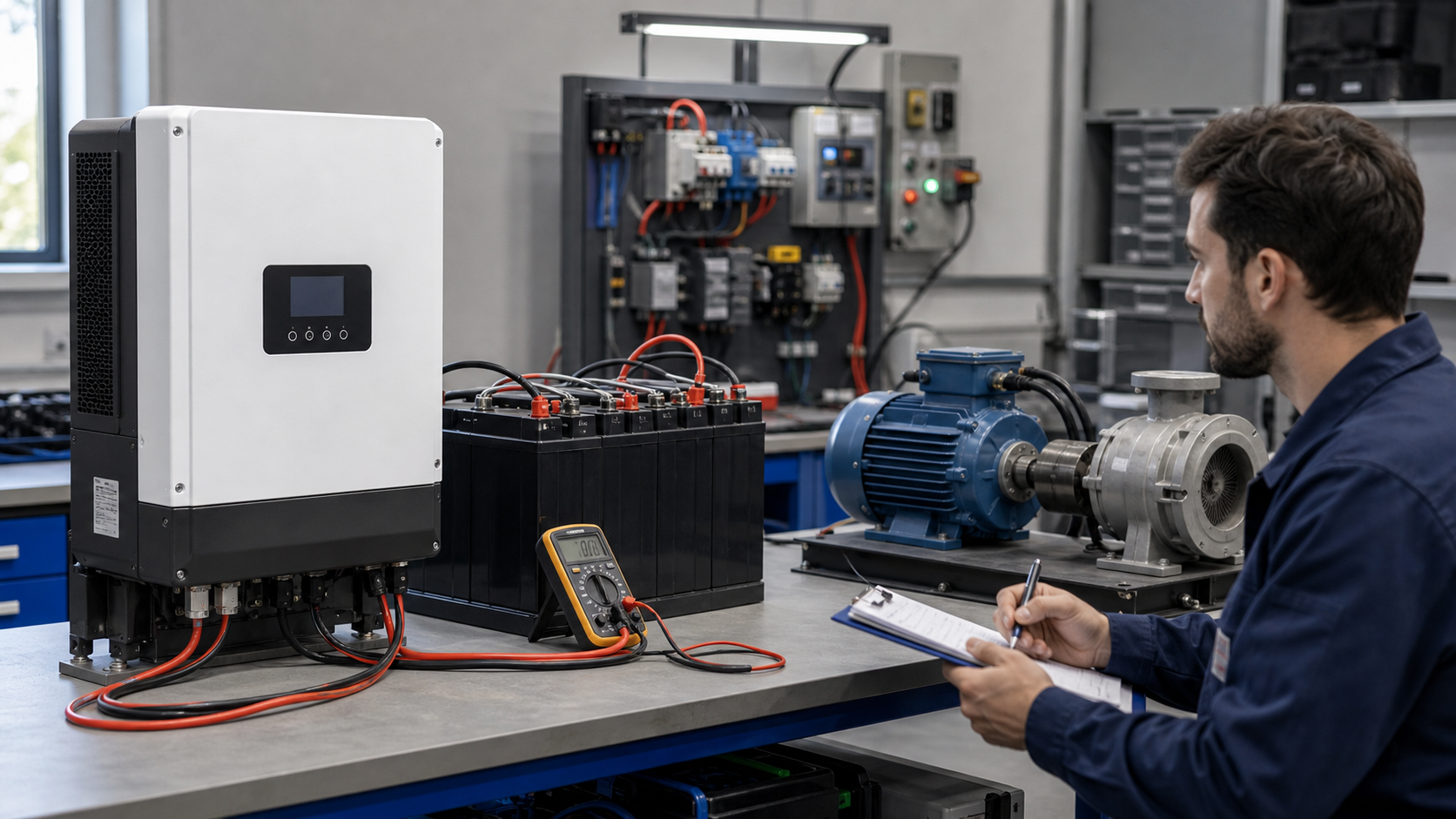
Do not relabel VA as W. Also distinguish battery operation from grid bypass: a load that starts with mains present may not start when the inverter must supply it from batteries. A dual-output inverter does not automatically provide its full rating independently on both outlets.
The supplier-provided GD series manual identified as 55304-200-507, section 7, printed page 30 (PDF page 33), lists the following values. Model codes below are reproduced as shown in that manual; they are not a declaration that GD Pro SMH or SMHB models are equivalent.
| Model code | Rated output | Peak capacity |
|---|---|---|
| 5048MH | 5000 W | 10000 VA |
| 6248MH | 6200 W | 12400 VA |
| 11048MH | 11000 W | 22000 VA |
That parameter table does not state how long the listed peak can be sustained. It therefore cannot establish that a motor needing a particular VA for one second will start. Request the exact model and firmware manual, overload-versus-time information, and battery conditions before accepting a startup claim. A figure twice the rated output is not a universal two-second or five-second guarantee.
The three listed models use a 48 V battery class in that table. This does not mean that every battery sold as 48 V has the current capacity or approved settings required by the inverter. For the current product family, use the Techfine literature entry and request the exact supplied manual. The linked entry is not a direct download of the particular document reviewed here.
For a pump or compressor, obtain manufacturer startup data or have a qualified technician measure the event with appropriate equipment. Record running current, startup current or VA, duration, supply voltage, phase, start method and the mechanical condition. A pump starting against pressure may present a different event from an unloaded test. A nameplate running wattage alone cannot settle the choice.
Illustrative screening example: assume verified load information says a motor requires 2.4 kVA for 0.8 seconds and 0.5 kVA of other loads remain on. An arithmetic screening sum is 2.9 kVA for that start interval. The selected inverter still needs adequate W and VA capability, a compatible current waveform and voltage response, and evidence covering the whole interval. This is a conservative screening sum, not a dynamic simulation or final approval.
If several devices can restart after an outage, examine their possible overlap. Starting loads sequentially may reduce the combined demand, but any sequencing, soft starter or drive must be approved for the motor and inverter. Do not assume an accessory will solve an undocumented compatibility problem.
A battery may contain enough kWh for hours of operation yet be unable to provide the current needed during starting. For a real-power screening calculation, DC current is approximately real AC power divided by battery voltage and inverter efficiency. Use voltage under load, not only nominal voltage. Apparent power in VA cannot be inserted as real W without the necessary load information.
For a separate hypothetical example, 4000 W of real AC demand at 44 V under load and 90% efficiency requires 4000 / (44 x 0.90), or about 101 A, before other DC demands and additional losses. A battery limited to 100 A continuous discharge cannot be approved for that continuous example merely because it has sufficient energy. A startup event instead requires the battery’s documented pulse-current limit and permitted duration, together with the inverter’s own limits.
Confirm the pack’s BMS version, state of charge, temperature restrictions, voltage drop and protection requirements with the supplier and installer. Do not bypass protective devices or raise cutoff thresholds to force a motor to start. The battery backup calculation guide separately checks the energy needed after the load has started.
| Record | Evidence needed | Unresolved condition |
|---|---|---|
| Load event | Exact motor or appliance, running W and VA, startup demand and duration | Only running watts or a generic multiplier is available |
| Inverter | Model suffix, operating mode, temperature rating and timed overload data | A peak number has no time or conditions |
| Battery | Exact BMS, continuous and pulse limits, voltage under load and approved settings | Only Ah or nominal kWh is stated |
| Combined system | Installer-approved test conditions, other running loads and recorded results | A different model or mains-bypass test is used as proof |
Keep an unresolved item open until the supplier supplies the missing evidence. Victron’s Inverter Smart specifications illustrate why continuous VA, continuous W, temperature-specific output and peak capacity are separate fields. Those ratings do not apply to the GD equipment in the table above.
No. A load below that running wattage can still exceed startup current, VA or duration limits. Other operating loads, temperature and battery capability also matter.
No. Waveform type is only one requirement. The inverter still has to sustain the event without excessive voltage reduction or a protective shutdown, within the manufacturer’s documented conditions.
Not necessarily. Extra array capacity does not remove the inverter’s AC output limit, guarantee sunlight during the event or override the battery BMS. First identify which limit caused the shutdown using the correct diagnostic procedure.
Send the load nameplate, available startup data, existing running loads, inverter and battery models, AC voltage and phase through the Suntrica contact page. We can use these details to coordinate a supplier review of the solar inverter options. Suntrica is a sourcing and supply business; no load-starting guarantee is implied before the matched system is verified.
Reviewed 22 September 2026. Numerical examples are illustrative, not test results or wiring instructions. Final selection and commissioning require model-specific evidence and a qualified installer.
Check MPPT charger PV voltage, input current and battery output separately. Use cold-voltage and charging-current examples before selecting a controller.
View details
Plan solar OEM ODM cooperation with sample acceptance, batch release checks, revision control and private-label certification review for each product.
View details
Choose a solar pump controller by motor type, voltage, current, PV input and water level protection. Use a practical checklist before requesting a matched quote.
View details
Compare off-grid and hybrid solar inverters by grid connection, battery use, backup operation, PV input, generator support and future expansion.
View details