 Soluções de Energia Solar Suntrica








PROCURE O QUE QUISER
Pesquisar tudoProdutoNotícias
PESQUISAR
An off-grid solar kit for a telecom site must support the equipment’s actual electrical interface and service requirement around the clock. Panel wattage and battery capacity are only part of the decision. The site also needs a defined response to low energy, equipment faults, loss of communications and delayed maintenance access.
A small repeater, a monitoring station and a multi-operator tower can have very different demands. Specify the installed equipment and operating conditions before comparing packages. A domestic backup kit is not automatically a telecom power plant.
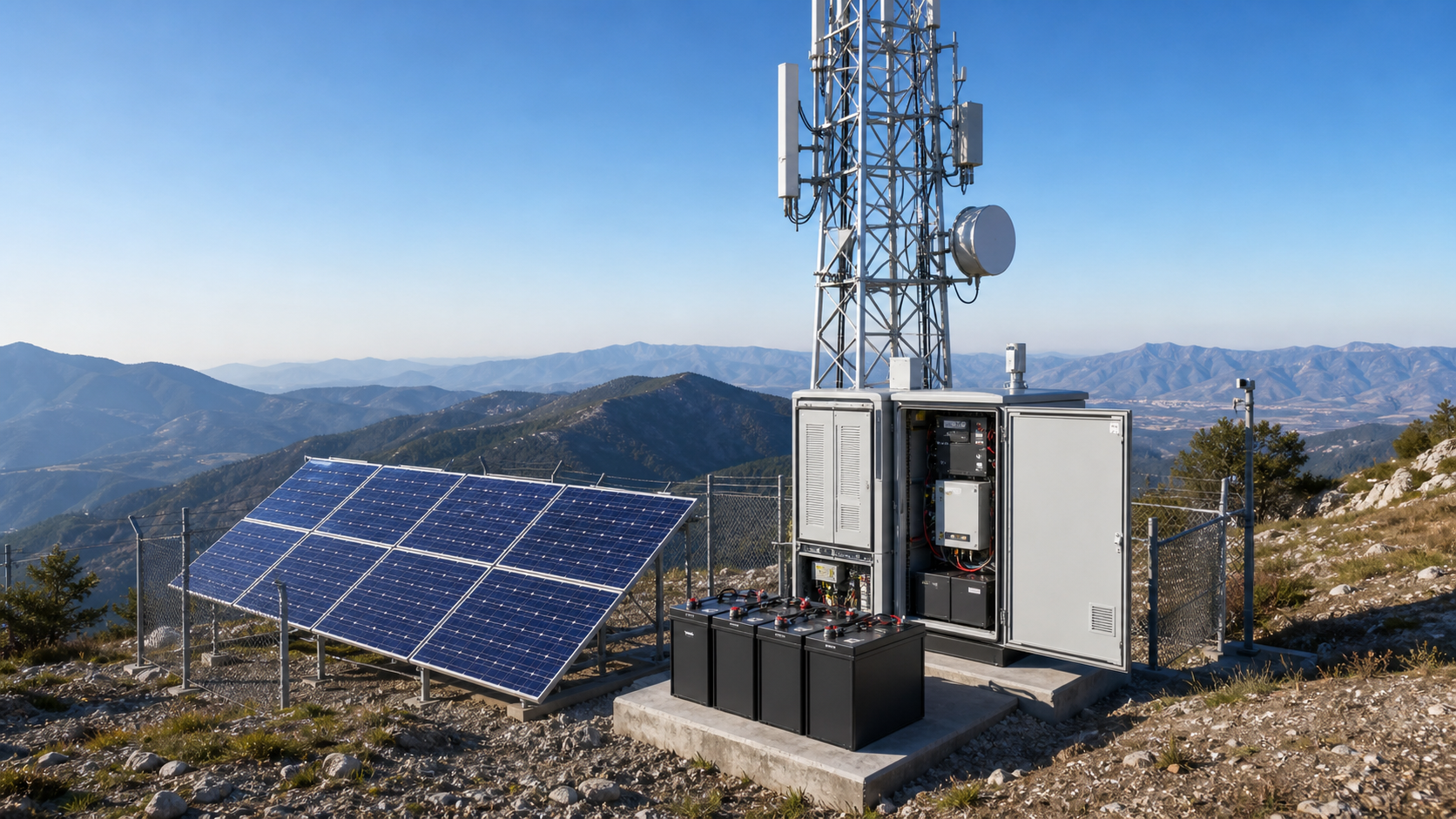
List radio equipment, backhaul, routers, controls and any enclosure cooling or heating. Identify which loads cannot be interrupted and which may be reduced under an approved low-energy policy. State the outage tolerance and who authorizes load shedding; do not use a generic claim of continuous service as a design target.
The GSMA Mobile Net Zero Report 2026 discusses solar-hybrid retrofits and batteries for weak-grid and off-grid tower sites, as well as responsibilities between operators and tower companies. For a buyer, the practical implication is to agree who provides energy data, who receives alarms and who owns the response. The report is industry context, not evidence that a particular kit will meet a service-level agreement.
Obtain the equipment input-voltage range, maximum demand, return and earthing arrangement, polarity requirements and permitted interruption behaviour. Some installations need DC distribution; others include AC auxiliaries. The circuit design must explicitly address both.
For a technical example, the Vertiv Solar Energy Solutions for Telecom catalogue describes a nominal -48 VDC NetSure architecture with model-specific conversion and control equipment. This is not interchangeable with a consumer product carrying a 48 V label.
Ask the integrator to verify the battery operating window, protection coordination, grounding compatibility, charging limits and controller communication for the exact supplied revisions. Neither a 51.2 V nominal label nor the presence of CAN or RS485 proves compatibility. Do not connect a candidate battery directly to a live telecom bus as an informal test.
Use logged operation where available, including busy periods and environmental loads. If different meters measure before and after converters, reconcile their boundaries before combining the figures. Otherwise conversion losses may be missed or counted twice.
Consider a hypothetical small site with these inputs measured at a common DC supply bus:
These are illustrative values, not measured tower data or a sizing recommendation. They show why a modest continuous load increase matters. Peak output, battery current and cooling at extreme conditions still need separate checks. Refer to the battery runtime calculation guide only after defining the correct loads and electrical boundary.
Specify how much service must remain during low-sun periods and what happens afterward. A battery can pass a single discharge demonstration yet fail to recover if the array only covers average daily use. Include seasonal generation, continuing loads and the allowed recharge time in the review.
Where a generator is part of the design, agree its start conditions, permitted charging demand, fuel and maintenance arrangements. Where fuel backup is unavailable, make that constraint explicit. A solar-only site must not inherit a calculation that silently assumes generator support.
Remote access changes the operational requirement. Compare the expected remaining reserve at an alarm threshold with the time to diagnose, travel and complete an approved repair. Do not use the theoretical runtime from a full new battery as the reserve available when an alarm is finally received.
A dashboard needs a defined response, not just attractive graphs. Use the following proposed matrix to agree alarm ownership, evidence and response procedures with the operator. Thresholds and safe actions must come from the approved system design.
| Condition | Evidence to retain | Response to define |
|---|---|---|
| Energy reserve falling | Battery state, load trend and recent generation | Who reviews the cause and when support is dispatched |
| Charging equipment fault | Affected module, source status and available capacity | Whether remaining equipment can sustain the agreed service |
| Battery protection event | Event code, current and temperature history | Manufacturer-approved recovery and escalation |
| Cooling failure | Enclosure temperature and cooling status | Approved derating or controlled shutdown procedure |
| Communications lost | Last received timestamp and local data retention | How loss of visibility is detected and investigated |
| Generator unavailable | Start attempt, source status and remaining reserve | Approved fallback and maintenance ownership |
Check the monitoring path itself. If it uses the equipment whose supply is failing, an event may stop being reported. Ask how local records are retained and how the receiving system identifies stale data. Arrange secure, authorized access rather than exposing a management interface directly to the public internet.
Before acceptance, have qualified personnel verify the documented interface and demonstrate the agreed operating modes with representative loads. Confirm that alarms arrive at the intended destination and that normal service resumes according to the approved recovery sequence. Do not bypass battery protection or run critical equipment to a damaging shutdown for demonstration purposes.
If redundancy is promised, ask exactly which failure is covered. An extra conversion module may not protect against a shared controller, distribution path or communications failure. Require the remaining capacity and the test conditions to be stated rather than interpreting a spare module as whole-system redundancy.
Keep the approved configuration, alarm list, maintenance schedule and spares arrangement with the operator. For enclosure transport and local installation responsibilities, use the separate container deployment checklist; a shelter and its power function are different scopes.
No. The required architecture depends on the DC and AC loads and approved power interfaces. An AC inverter should serve a defined need rather than being added automatically to a DC design.
Not on its nominal voltage alone. The integrator must approve the full electrical, environmental, protection and control interface for that model and application.
No. The timing of generation, low-sun sequences, faults, recovery capacity and maintenance response all matter. Annual energy totals do not establish the service availability of an unattended site.
Provide equipment input specifications, load logs, site conditions, service priorities and backup-source constraints through Contacte-nos. Suntrica can coordinate supplier information for solar modules e battery options. Telecom qualification and the final integrated design must be established for the quoted equipment, not inferred from the general product categories.

Verify a China solar supplier through model documents, certificate scope, batch inspection and delivery records. Use an evidence checklist before bulk orders.
Ver detalhes
Compare LiFePO4 batteries by usable kWh, current limits, cycle test conditions and BMS control. See why equal capacity does not mean equal output power.
Ver detalhes
Check what a hybrid inverter powers during outages, including essential circuits, transfer limits, battery reserve and restart. Plan a witnessed handover test.
Ver detalhes
Plan solar OEM ODM cooperation with sample acceptance, batch release checks, revision control and private-label certification review for each product.
Ver detalhes