 Soluções de Energia Solar Suntrica








PROCURE O QUE QUISER
Pesquisar tudoProdutoNotícias
PESQUISAR
Compare LiFePO4 storage batteries by usable energy, permitted power and documented operating conditions, not ampere-hours or cycle count alone. Two batteries marked 51.2V 100Ah can store a similar nominal amount of energy while supporting very different loads because of their BMS, cell and current limits.
This guide provides a comparison method for distributors and solar-system buyers. It is not a charging-settings sheet. The final selection must use the exact battery revision, inverter requirements and manufacturer-approved configuration.
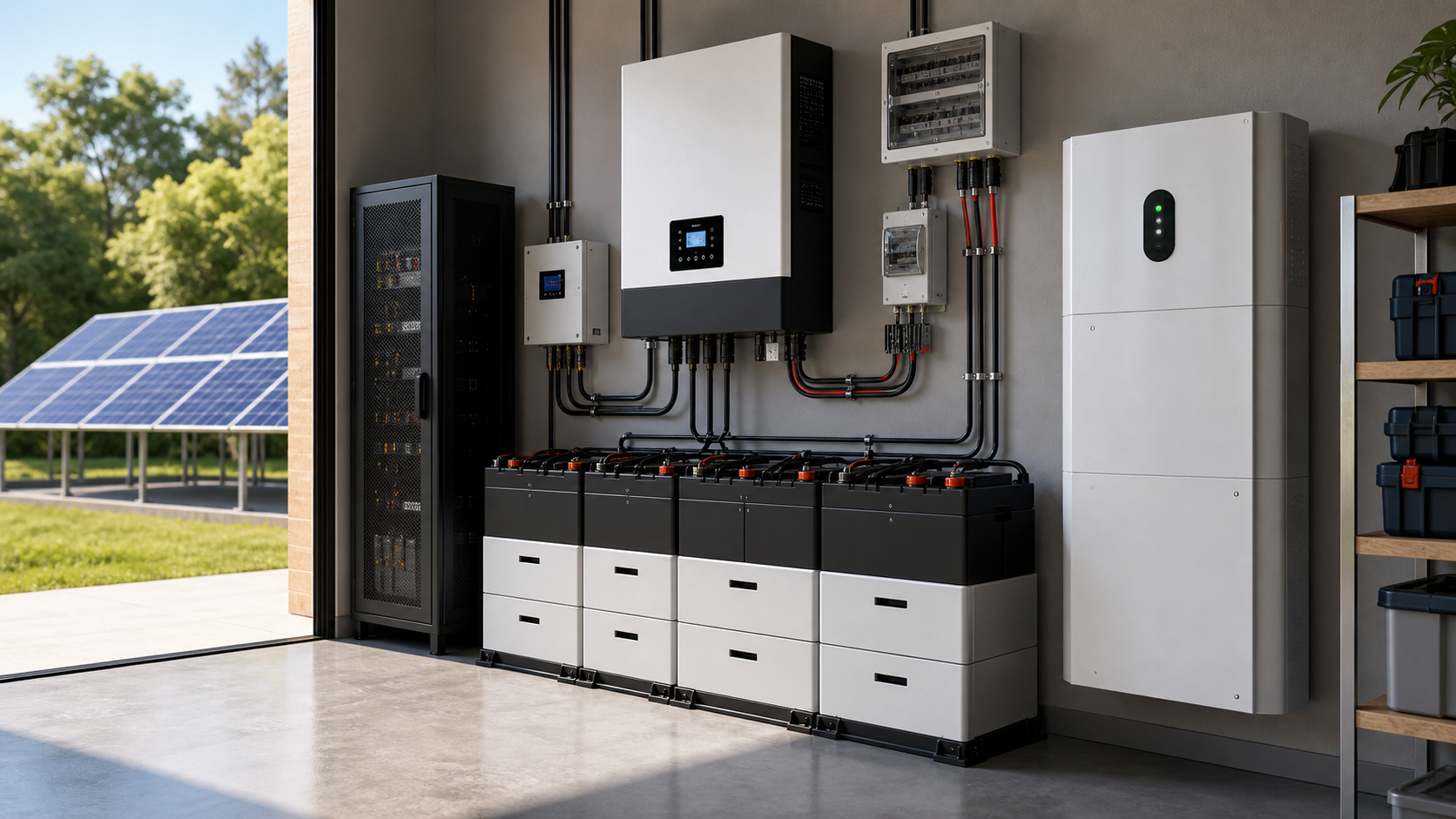
LiFePO4, also called LFP, identifies lithium iron phosphate cell chemistry. It does not specify the enclosure, BMS, fuses, communication settings or installation approval. A cell data sheet cannot answer every question about the assembled battery pack.
Start with a full model number and revision. Identify whether the BMS is internal or a separate required component, then request the charge and discharge limits for the complete pack. Different products can use the same nominal voltage while requiring different control arrangements.
A useful first comparison is nominal voltage multiplied by rated ampere-hours. For an illustrative 51.2V 100Ah battery, this is 51.2 x 100 / 1000 = 5.12 kWh nominal energy. It is not a promise of 5.12 kWh at the household sockets.
Suppose the design uses a 90% starting state of charge and stops discharge at 20%. The assumed working window is 70 percentage points, giving 5.12 x 0.70 = 3.584 kWh before conversion losses, auxiliary consumption, temperature effects and ageing. These percentages are example assumptions, not recommended settings for a particular model.
Confirm how a supplier defines any quoted usable-energy figure: DC or AC, new or aged battery, temperature, discharge rate and cutoff. If it already includes a specified discharge window, do not deduct the same reserve twice. For an hourly load calculation, use the battery backup time guide.
The following candidates are hypothetical, not products offered by Suntrica. Both have identical nominal capacity and the same assumed SOC window. Only their continuous discharge limit differs.
| Comparison item | Candidate A | Candidate B |
|---|---|---|
| Nominal voltage and capacity | 51.2V and 100Ah | 51.2V and 100Ah |
| Nominal energy | 5.12 kWh | 5.12 kWh |
| Assumed 90% to 20% SOC window | 3.584 kWh before losses | 3.584 kWh before losses |
| Assumed continuous discharge limit | 50 A | 100 A |
| DC power at an assumed operating voltage of 48V | 2.40 kW | 4.80 kW |
| Converted power at an assumed 92% efficiency | 2.208 kW before auxiliaries | 4.416 kW before auxiliaries |
The power calculation is operating voltage x permitted current x assumed conversion efficiency. It uses 48V as an example operating point, not the nominal 51.2V. Actual voltage changes during discharge. These figures are only battery-side screening results; inverter capacity, wiring, protection, temperature and other limits can reduce the available output.
Candidate B does not store twice as much energy. It can support a higher assumed current within the stated conditions. A short peak-current rating must not replace a continuous rating, and the permitted peak duration must cover the intended event. See the load startup guide for that separate check.
A cycle count needs its test depth of discharge, temperature, charge and discharge rate, and remaining-capacity endpoint. As a documented example, Victron’s 51.2V Lithium NG specification lists different cycle counts for different depths of discharge, with an endpoint of at least 80% nominal capacity. Those values describe that battery, not every LFP pack.
Do not convert an advertised cycle count directly into guaranteed calendar years. A warranty may have separate time, throughput, retained-capacity and operating-condition terms. Ask for the actual warranty document and the claim process rather than relying on a headline about design life.
For sensitivity analysis only, if the example battery later retains 80% of its original capacity, the same 70% operating window becomes 5.12 x 0.80 x 0.70 = 2.867 kWh before conversion and other losses. This is an assumed ageing scenario, not a prediction of when degradation will occur.
Ask for the approved inverter models and firmware, the required protocol selection and cable pinout, and the behaviour if communication fails. A CAN or RS485 socket alone is insufficient evidence. Confirm that current requests and protection states are handled as intended by both devices.
Check aggregate charging current when PV charging and another charging source can operate together. The SuperPack NG configuration guidance explicitly distinguishes combined current limits and battery-specific charger settings. Use the selected battery’s own values; another manufacturer’s profile is not a substitute.
Also separate the cold-weather discharge limit from the charging limit. The Lithium NG reference above specifies different temperature ranges for the two operations. Heating, low-temperature charge blocking and recovery are model features that need confirmation, not inherent guarantees of LFP chemistry.
Safety documentation also has a defined scope. UL’s explanation of UL 9540 and UL 9540A distinguishes system safety requirements from a fire-propagation test method. Neither a chemistry name nor an unrelated report proves approval of the proposed installation.
No. Ampere-hours must be considered with voltage. For example, 12.8V x 100Ah is 1.28 kWh nominal, while 51.2V x 100Ah is 5.12 kWh nominal. Both still need a usable-energy definition.
No. A higher permitted current can change the power capability, but it does not itself add cell capacity. Only a manufacturer-approved complete battery configuration should be compared; modifying a BMS is not a capacity upgrade.
Not simply because they share chemistry and nominal voltage. Obtain manufacturer approval for the exact combination, control arrangement, age and operating conditions. A quotation should identify the approved modules rather than promise universal expansion.
Share the battery data sheets, inverter model and essential-load requirement with Suntrica. We can coordinate missing documents with suppliers and compare options in our energy storage battery range. For the physical installation decision, use the wall battery site survey guide.

Compare commercial solar payback using onsite consumption, export value and installed cost. Review a worked sensitivity example and avoid double-counted savings.
Ver detalhes
Modular 51.2V 100Ah stackable LiFePO4 home battery with expandable 5.12–15.36kWh capacity for solar storage, backup and off-grid systems.
Ver detalhes
Solução de sistemas de energia solar autónomos para explorações agrícolas, residências, locais remotos e projetos comerciais de energia de reserva, incluindo painéis, inversores híbridos e baterias.
Ver detalhes
Learn how to choose a 3–8kW single-phase hybrid solar inverter by matching household loads, PV string voltage, MPPT current, 48V battery capacity, backup circuits, grid requirements and future expansion.
Ver detalhes