 Soluções de Energia Solar Suntrica








PROCURE O QUE QUISER
Pesquisar tudoProdutoNotícias
PESQUISAR
Battery backup time is the energy available over the allowed discharge window divided by the power drawn from the battery. A useful estimate includes the actual starting charge, reserve limit, inverter losses and auxiliary consumption. Dividing the advertised battery kWh by the appliance kW alone can overstate runtime.
This guide covers battery-only backup with no incoming solar or grid energy during the example. It separates energy calculations from the current and startup limits that can stop a system even when energy remains. The examples are planning calculations, not measured product performance or recommended battery settings.
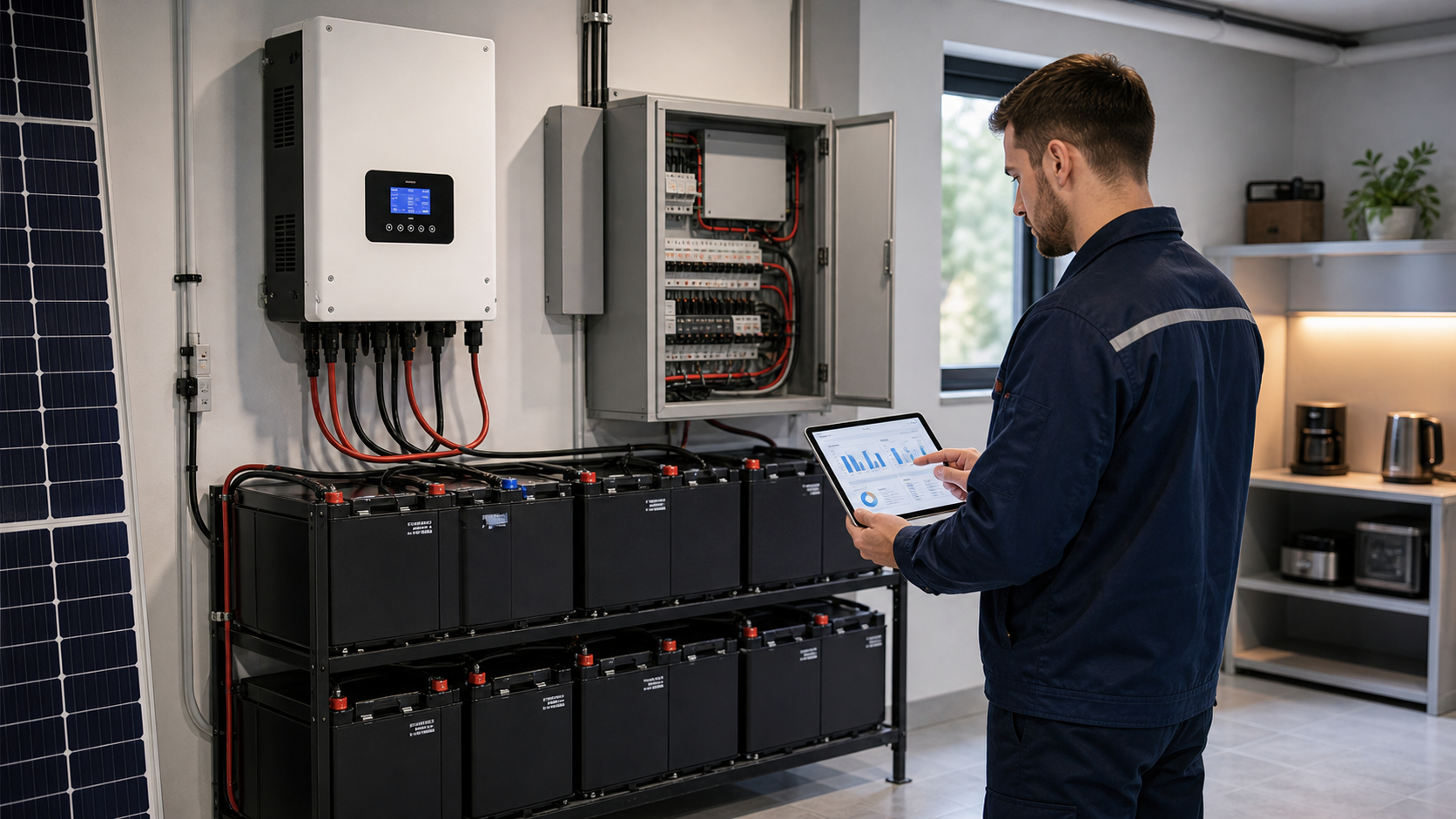
For an initial energy estimate, nominal watt-hours equal nominal battery voltage multiplied by rated amp-hours. Thus a hypothetical 51.2 V, 100 Ah pack has 5120 Wh, or 5.12 kWh, of nominal energy. A 12.8 V, 100 Ah pack is not equivalent: the same amp-hour label at a different voltage represents a different energy quantity.
Suntrica’s supplier-provided Techfine battery catalogue lists a 51.2 V, 100 Ah LC version, but the full model, BMS configuration and documentation must match the delivered pack. Do not treat the nominal-energy arithmetic as a guaranteed usable AC output. The manufacturer’s LC series page is a reference entry; request the exact model sheet when selecting equipment.
For a preliminary state-of-charge estimate, multiply nominal energy by the difference between starting SOC and the chosen lower SOC limit. Use fractions, not whole percentage numbers. If a manufacturer already specifies usable energy over that same window, do not apply the discharge fraction a second time. Confirm the definition and test conditions.
Assume a new 51.2 V, 100 Ah battery starts at 90% SOC and operation stops at 20%. For this example only, assume 90% variable conversion efficiency plus a separate 20 W DC auxiliary draw. There are no other DC loads, no charging input and no additional capacity derating in this simplified calculation.
The general calculation is runtime in hours = available DC energy in Wh / total DC demand in W. In a component estimate, total DC demand is AC load divided by conversion efficiency, plus separately accounted auxiliary and direct DC loads.
Do not double-count losses. If measured battery power already includes the inverter, auxiliaries and all connected loads, use that total directly. If a quoted overall inverter efficiency already includes self-consumption, do not automatically add a separate idle-power allowance. A datasheet’s maximum efficiency is not necessarily its efficiency at your operating load.
This table uses the same hypothetical 3584 Wh discharge window, 90% conversion factor and separate 20 W auxiliary draw. It changes only the steady AC load. Actual efficiency, temperature effects and available capacity will vary.
| AC load | Total DC draw | Runtime |
|---|---|---|
| 100 W | 131.1 W | 27.3 hours |
| 300 W | 353.3 W | 10.1 hours |
| 800 W | 908.9 W | 3.9 hours |
| 1500 W | 1686.7 W | 2.1 hours |
For an eight-hour target at 300 W under these assumptions, the energy requirement is 353.3 x 8 = approximately 2827 Wh. The example’s 3584 Wh exceeds that calculated requirement, but the difference is not a reliability guarantee. Ageing, low temperature, unexpected loads and early low-voltage cutoff can reduce the practical reserve.
Record each load’s measured or documented power and operating duration. A refrigerator or pump does not necessarily draw its nameplate power continuously; a brief motor start also needs a separate power check. Avoid adding every device at full power for 24 hours unless that is the real operating pattern.
For a second illustration, suppose total AC demand is 300 W for four hours and 150 W for the next six hours. AC energy is 300 x 4 + 150 x 6 = 2100 Wh. With the same simplified conversion factor and 20 W auxiliary draw over ten hours, battery energy demand is 2100 / 0.90 + 20 x 10 = about 2533 Wh. Compare this with the energy available at the actual outage start, not an assumed fully charged pack.
If solar generation continues during backup, calculate generation and demand by time interval and respect charging limits. Do not subtract a full day’s predicted PV energy from an overnight requirement. PV recharge sizing is a separate task from this discharge-only calculation.
Victron’s battery capacity guidance explains discharge-rate effects. Its inverter specification table separately lists zero-load consumption and temperature-specific output. These references explain the method; their product values are not assigned to a Techfine system.
There is no single duration. First establish usable energy at the starting charge and reserve setting, then divide by total battery-side demand. In the worked 5.12 kWh nominal example above, a 300 W AC load gives about 10.1 hours under the stated assumptions, not 5.12 / 0.3 hours.
No. Maximum efficiency is a particular operating point, not a promise across all loads. Use a suitable efficiency curve or measured battery-side demand, and establish whether self-consumption is already included.
Not automatically. Only an approved parallel arrangement with compatible packs, wiring, protection, settings and balanced current sharing can be assessed. Temperature, starting SOC and limits still apply. Do not connect unmatched packs based on nominal capacity alone.
Send the critical-load list, operating schedule, target hours, inverter model, battery model, site temperature range and expected starting charge through the Página de contacto da Suntrica. Our energy storage battery range provides product starting points; final selection needs the exact pack and BMS data.
Reviewed 22 September 2026. Example assumptions are not product settings or a field-test result. Final electrical design and commissioning require the applicable manufacturer documentation and a qualified installer.
Plan off-grid telecom solar power around DC interfaces, continuous demand, battery recovery and actionable alarms. Review service priorities before ordering.
Ver detalhes
Match a LiFePO4 battery with a solar inverter by checking voltage, usable energy, BMS current, charging limits, surge power and communication protocols.
Ver detalhes
Plan solar OEM ODM cooperation with sample acceptance, batch release checks, revision control and private-label certification review for each product.
Ver detalhes
Compare off-grid and hybrid solar inverters by grid connection, battery use, backup operation, PV input, generator support and future expansion.
Ver detalhes