 Suntrica — решения в области солнечной энергетики







НАЙДИТЕ ТО, ЧТО ВАМ НУЖНО
Поиск по всему сайтуПродуктНовости
ПОИСК
A 48V brushless DC solar deep-well pump can be a practical irrigation solution where grid power is unavailable or unreliable. The pump discussed here uses a 304 stainless-steel body and works with a dedicated solar pump controller, making it suitable for transferring groundwater to field channels, storage tanks or local irrigation points.
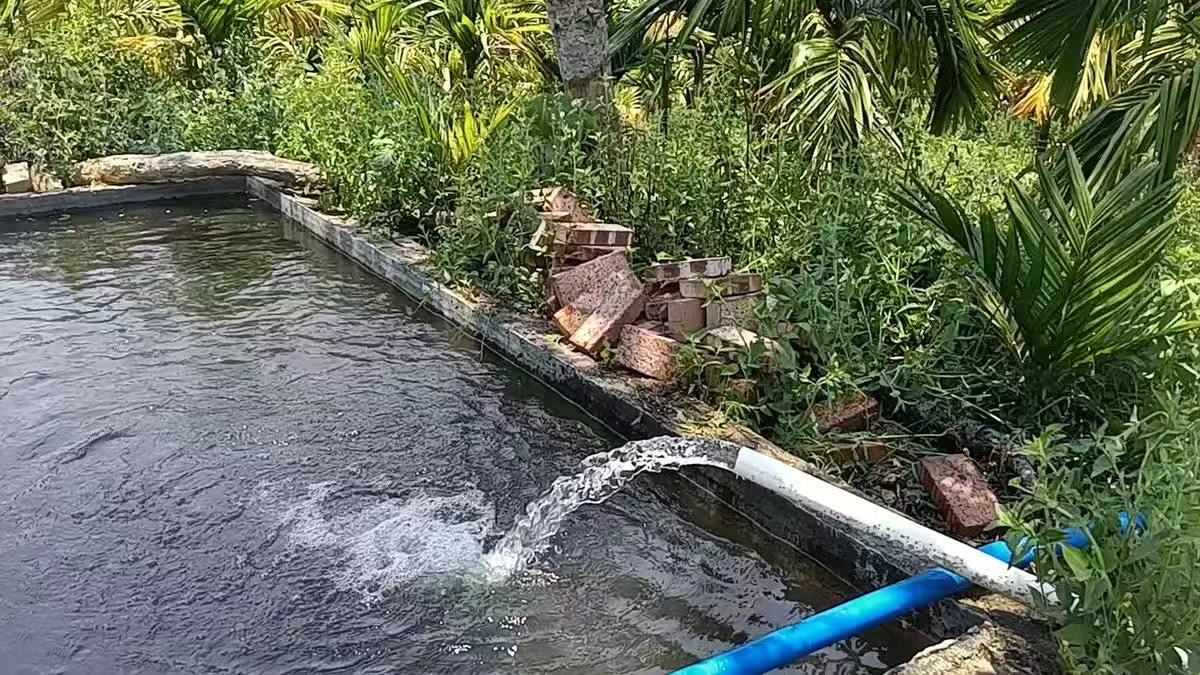
A 48V DC system is commonly used for small and medium solar pumping duties. Compared with low-voltage 12V or 24V systems, it can deliver the same electrical power at a lower current, helping reduce cable losses and conductor size. Compared with high-voltage pump systems, it is easier to integrate into compact off-grid installations.
A brushless DC motor eliminates carbon brushes and mechanical commutation. This reduces routine maintenance and avoids brush wear, an advantage when the pump is installed in a deep well and removal is difficult. The controller electronically manages motor operation and adjusts the pump to the available solar power.
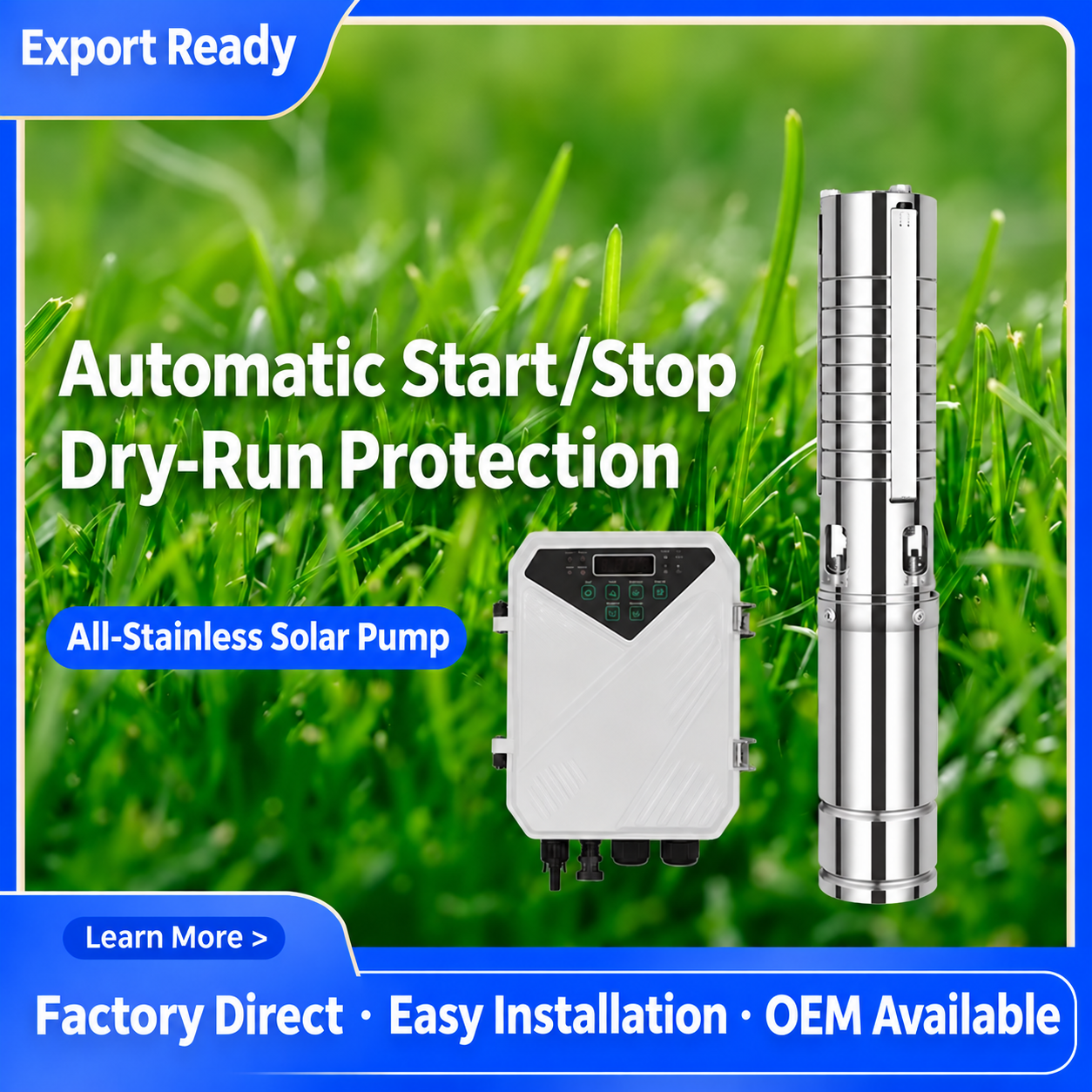
304 stainless steel is widely used for the external pump body because it provides good corrosion resistance in many freshwater environments and offers a clean, durable structure. It is suitable for typical wells, tanks and agricultural water sources where chloride levels are not unusually high.
Material descriptions should still be checked carefully. “All stainless steel” can refer to the outer casing, hydraulic components or a broader set of internal parts depending on the model. For brackish water, saline water or chemically aggressive sources, 304 stainless steel may not be sufficient; 316 stainless steel or another corrosion-resistant construction may be required.
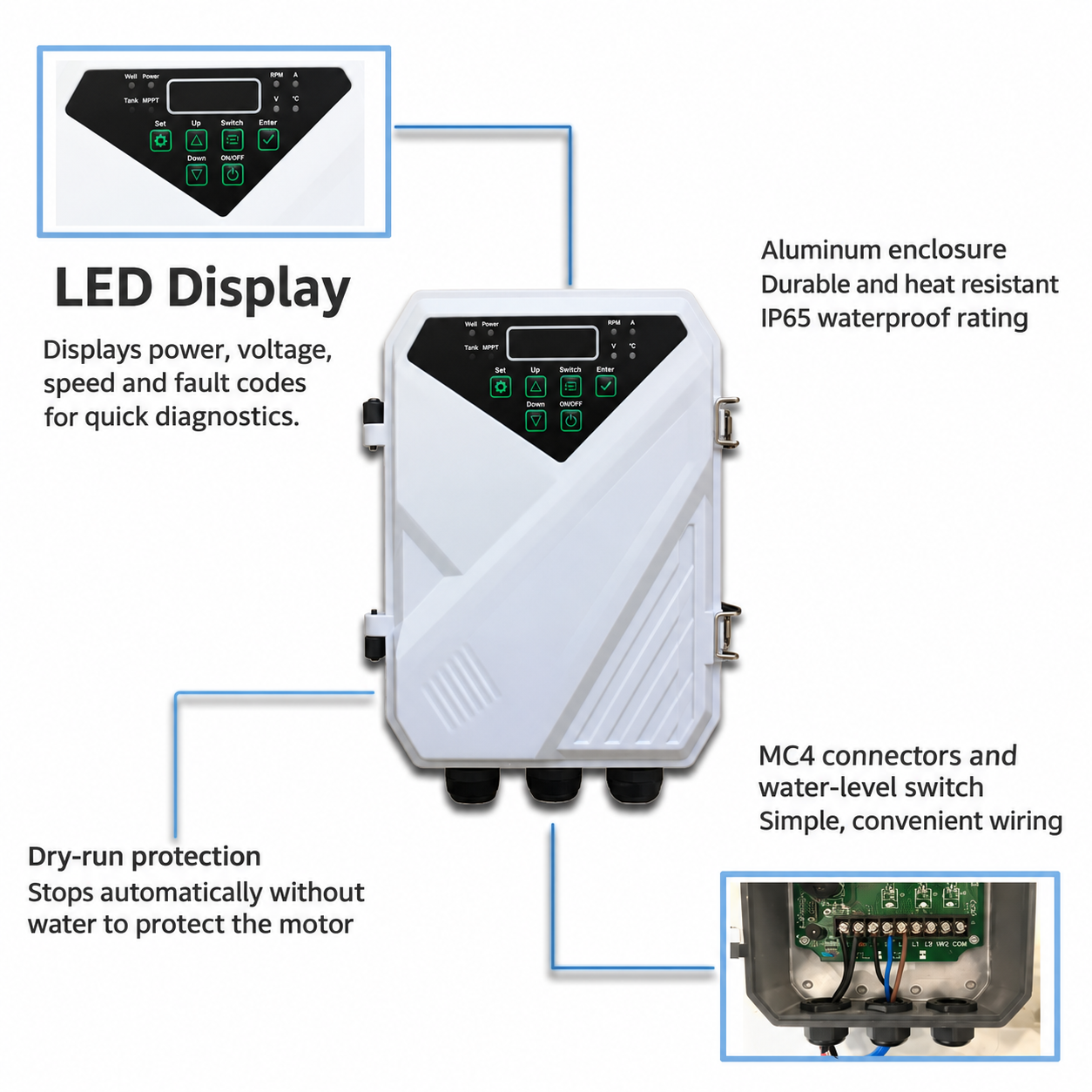
The controller sits between the PV array and the pump motor. Its job is to start the pump when sufficient solar energy is available, regulate motor speed and protect the system during abnormal conditions. An LED display can show operating values such as power, voltage and speed, while fault codes help identify problems without immediately lifting the pump from the well.
The illustrated controller uses an aluminium enclosure with an IP65 protection rating, MC4-type PV connections and an input for a water-level switch. Dry-run protection stops the motor when the water source is depleted, helping prevent overheating and premature damage.
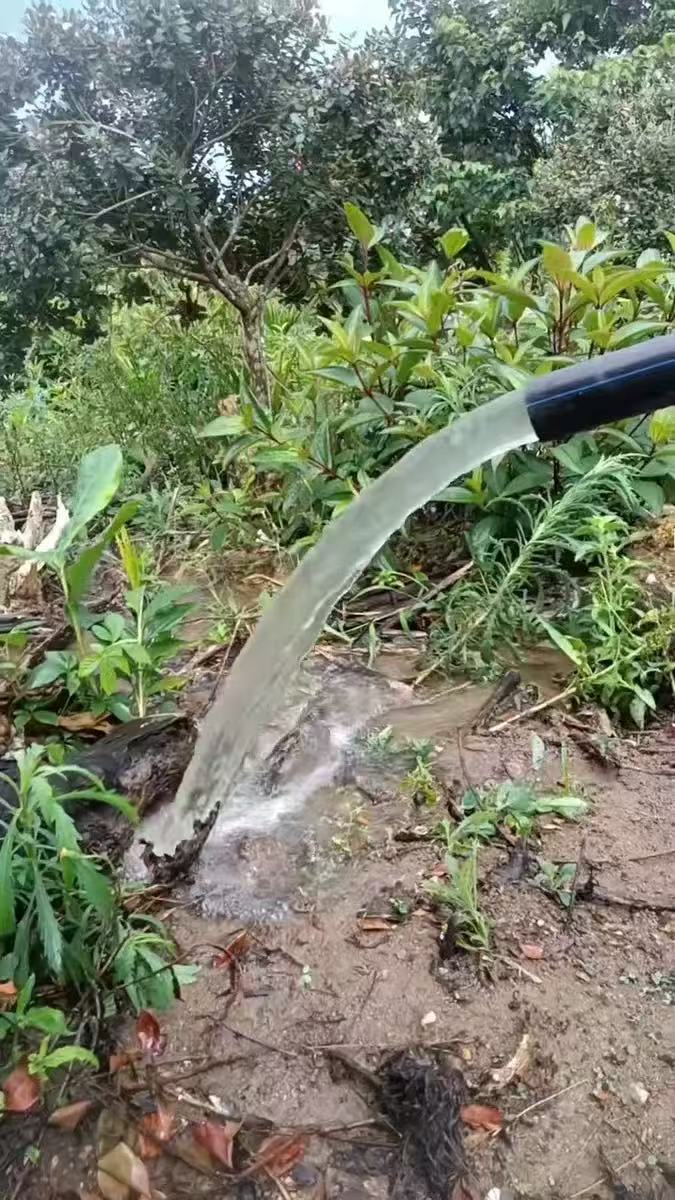
Solar pumping is most effective when water demand and sunshine occur during the same period. Instead of relying on a large battery bank, many farms pump water during the day into a tank, lined pond or elevated reservoir. Stored water can then be distributed when required.
Direct discharge to a field is also possible, but flow will vary with solar irradiance unless the system includes storage or another means of pressure regulation. Drip irrigation and sprinkler systems may require additional filters, pressure control or a buffer tank.
Total dynamic head (TDH) combines the vertical lift with friction loss and any outlet pressure requirement. A 20-metre well does not automatically mean a 20-metre pump head. If the pumping water level is 15 metres below ground, the storage tank is 8 metres above the wellhead and the pipework adds 5 metres of loss, the duty point is already about 28 metres before adding a safety margin.
The pump curve must pass through the required flow at the calculated TDH. Maximum head and maximum flow are end points of a curve; they do not occur at the same time.
The controller has an allowable PV input-voltage range and a maximum current. The number of modules in series must provide enough voltage for operation while remaining below the controller’s maximum open-circuit voltage in cold weather. Array wattage should also account for high module temperature, dust, cable loss and weaker morning or afternoon sunlight.
For a 48V pump, the PV array voltage may be higher than 48V because the controller converts the available solar power to the motor’s operating requirements. Do not connect modules based only on the pump’s nameplate voltage. Use the controller’s PV input specifications and the module datasheet.
| Project input | Why it matters |
|---|---|
| Well depth and pumping water level | Determines the principal vertical lift |
| Daily water demand and operating hours | Sets the required average flow |
| Tank elevation and pipe route | Adds static and friction head |
| Location and available PV modules | Supports array sizing and voltage checks |
| Water quality | Influences materials and pump type |
A 304 stainless-steel 48V brushless DC solar deep-well pump is a useful option for small farms, orchards, livestock watering and remote irrigation. Its value comes from matching the complete system—pump curve, controller, PV array, pipework and storage—to the actual duty point.
For a pump recommendation, provide the well depth, pumping water level, required daily volume, delivery height, pipe length and installation location. We can compare suitable flow-head curves and prepare a matched pump, controller and solar-array proposal.
See what a 720W solar panel pallet label reveals about module quantity, shipping weight and traceability, plus the checks needed before project delivery.
Посмотреть подробности
Match solar panel wattage to daily loads and battery recharge. Compare solar-hour scenarios, charging limits and reserve recovery with worked examples.
Посмотреть подробности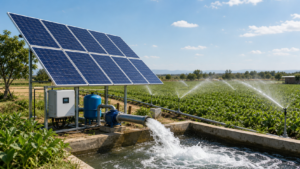
Size farm irrigation solar panels around seasonal water demand, head and sunlight. Use a worked energy example and controller compatibility checks.
Посмотреть подробности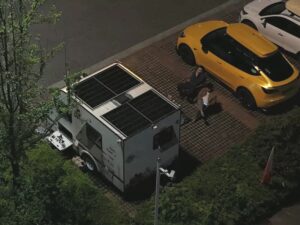
See how a 950W RV solar array reached about 928W and learn how an MPPT controller converts 66V PV input into 27V 34A battery charging.
Посмотреть подробности