 Solusi Energi Surya Suntrica







CARI APA YANG ANDA INGINKAN
Cari semuaProdukBerita
PENCARIAN
Solar power projects are not limited to one type of installation. Across industrial roofs, community streets, rural roads and small standalone sites, photovoltaic technology can be configured to meet very different energy needs. The most successful projects begin with the load and the site—not with the number of panels.
The application images reviewed for this article illustrate several common project patterns: solar modules installed on a metal roof, standalone solar street lights in parks and residential areas, LED lighting equipment in production, wall-mounted off-grid control equipment and a compact ground-mounted array. Together, these scenes show how the same basic energy source can support buildings, public lighting and remote infrastructure.
A large, open roof can turn unused space into a local power source. Metal-roof installations are especially common on workshops, warehouses, farms and light-industrial buildings because the roof area is often unobstructed and close to daytime electrical loads.
Before choosing modules, the project team should check roof age, structural capacity, sheet condition, drainage, wind exposure and the location of skylights or vents. The mounting method must match the roof profile and preserve waterproofing. Cable routes, inverter access and safe maintenance paths should be planned before installation begins.
Orientation and shading also matter. A row of modules may look orderly, but vents, nearby buildings, trees or future construction can reduce output. The design should use site-specific solar-resource data and account for temperature, dirt and partial shade when estimating annual energy production.
Standalone solar street lights are useful where trenching and grid extension are difficult, disruptive or expensive. A typical system combines a PV module, LED luminaire, battery, controller, pole and foundation. Some products integrate the battery and controller into the luminaire, while others use separate components for easier capacity customization.
Correct sizing starts with lighting demand. Designers need the required illuminance, road width, pole height, spacing, operating hours and dimming schedule. Only then can they calculate daily energy consumption and match the panel and battery to local solar conditions.
Autonomy—the time the light must operate through poor weather—should be selected for the project climate and service requirement. Oversizing every component increases cost, while undersizing can cause early-night dimming, low-battery shutdowns and reduced battery life.
A solar street light is an energy system, not just a lamp attached to a panel. The efficiency and optical design of the LED luminaire determine how much battery capacity and solar power are required.
Quality checks should include input power, luminous distribution, color temperature, thermal management, driver protection and enclosure sealing. Good optics can deliver the required road illumination with less wasted light, while effective heat dissipation helps protect the LEDs and driver. Production consistency is important because a project may contain dozens or hundreds of identical units.
The wall-mounted equipment visible in small solar projects usually forms the control center of the system. Depending on the application, it may include a charge controller, inverter, DC and AC protection, monitoring, metering and battery connections.
Equipment should be arranged so technicians can identify circuits, isolate faults and perform service safely. Enclosures need appropriate ingress protection, ventilation and clearance. Cable entries should be sealed and supported, and protective devices should match the voltage, current and fault characteristics of the system.
For communication, monitoring or small facility loads, the energy calculation must include every device, its rated power, starting surge if applicable and its operating schedule. Continuous loads can consume more daily energy than a much larger device that runs only briefly.
When a roof is unsuitable or the load is located outdoors, a small ground-mounted array can be simple to inspect and expand. It may power security cameras, telecommunications equipment, pumps, lighting, sensors or a remote control cabinet.
Ground arrays still require careful civil and electrical design. The structure must suit the soil and wind conditions. Modules need clearance from vegetation, splash, drifting snow and standing water. The layout should allow cleaning without stepping on modules and should protect cables from animals, tools and vehicles.
A nearby equipment cabinet can reduce cable length, but it should not cast shade on the array. Drainage, corrosion, security and future access are often more important than making the installation as compact as possible.
List every device, its quantity, operating power, starting demand and hours of use. Separate daytime loads from nighttime loads. For street lighting, include dimming schedules; for motors and pumps, include starting characteristics; for monitoring systems, include communication equipment.
Record the project location, available roof or land area, shading, orientation, temperature range, wind, dust, rainfall, snow and access conditions. Photographs and basic drawings help identify installation constraints early.
Decide whether the project will be grid-connected, hybrid or fully off-grid. Grid-connected rooftop systems usually prioritize annual energy yield, while off-grid systems must balance daily generation, storage capacity and acceptable loss-of-load risk.
Panel voltage and current must stay within the controller or inverter operating limits across the expected temperature range. Batteries should provide the required usable energy without exceeding the recommended depth of discharge. Cables and protection devices must be sized for the actual circuit conditions.
Leave space for inspection, cleaning and component replacement. Label circuits, document settings and record serial numbers. Remote monitoring can reveal falling production, low battery state of charge or repeated faults before a site visit is required.
These details allow suppliers to propose a system around the real application instead of offering a generic panel-and-battery package.
Rooftop PV, solar street lights and small off-grid systems use many of the same components, but their design priorities are different. Rooftop projects focus on structural compatibility and annual energy yield. Street-light projects depend on lighting demand, nighttime autonomy and pole placement. Remote systems require careful load assessment, storage design and maintainable control equipment.
Suntrica menyediakan panel surya, inverter surya dan baterai penyimpanan energi for different project configurations. Contact us with your load list and site information for product matching and project support.
Size farm irrigation solar panels around seasonal water demand, head and sunlight. Use a worked energy example and controller compatibility checks.
Lihat detailnya
Compare solar pump system costs with a scope checklist for pumps, PV, piping, storage, installation and maintenance at the same water duty.
Lihat detailnya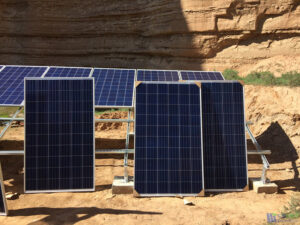
Perkirakan jumlah panel 400–600 W untuk inverter 5 kW. Periksa rentang tegangan MPPT, arus masuk, Voc saat dingin, dan kebutuhan pengisian baterai.
Lihat detailnya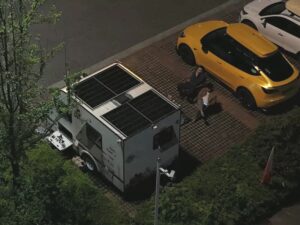
See how a 950W RV solar array reached about 928W and learn how an MPPT controller converts 66V PV input into 27V 34A battery charging.
Lihat detailnya