 Solusi Energi Surya Suntrica








CARI APA YANG ANDA INGINKAN
Cari semuaProdukBerita
PENCARIAN
Solar panels for farm irrigation should be sized around the water that must be delivered in the demanding irrigation month, not just the pump’s rated watts. Start with daily water volume, total dynamic head, the local solar resource and the matched pump-controller performance. Then check whether the proposed array can supply that duty within its electrical limits.
This guide focuses on the PV array for irrigation. It does not replace a crop-water assessment, borehole yield test or detailed electrical design. Suntrica supplies and sources equipment; the examples below are screening calculations, not results from a Suntrica farm installation.
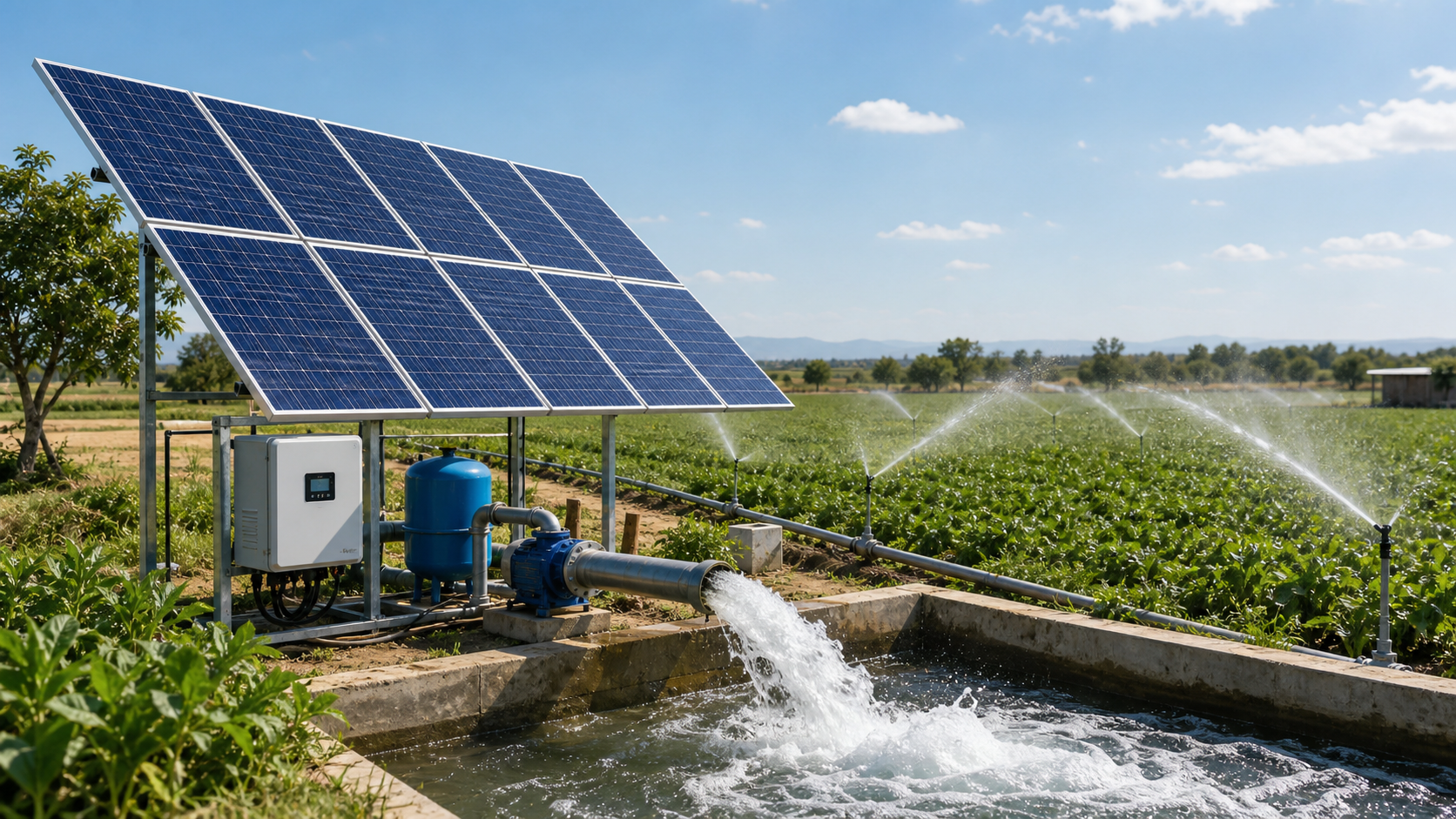
A farm can have its greatest water requirement in a different month from its strongest solar production. Record the irrigation season month by month: required water at the delivery point, pumping water level, distribution pressure, solar irradiation and any storage or backup available. The difficult month is the one with the least margin between required duty and achievable delivery, not automatically the darkest month of the whole year.
Use water demand that includes the relevant irrigation and conveyance losses, without adding a second allowance if those losses are already included. Ask an agricultural specialist to establish crop demand and scheduling. Verify sustainable source yield separately: adding PV capacity cannot create more groundwater or make unrestricted abstraction acceptable.
The GIZ/FAO SPIS design guidance treats seasonal water demand, solar conditions and system pressure as linked inputs. For the pump duty itself, use our farm and well pump sizing guide.
For fresh water, hydraulic energy in kWh per day is approximately 0.002725 x daily volume in m3 x total dynamic head in metres. This comes from mass, gravity and lift, using water density of 1000 kg/m3 and gravity of 9.81 m/s2. Total dynamic head includes the pumping water level, delivery elevation, required pressure head and pipe losses at the assessed flow. It is not simply the drilled depth of the well.
Consider an invented planning case requiring 30 m3 per day at 40 m total dynamic head. Hydraulic energy is 0.002725 x 30 x 40 = 3.27 kWh per day. If an illustrative combined controller, motor and pump efficiency were 40%, the controller-input energy requirement would be 3.27 / 0.40 = 8.175 kWh per day.
Now assume 4.5 equivalent full-sun hours on the array plane and a separate 80% PV-side delivery factor for module temperature, soiling and upstream electrical losses. The rough array estimate is 8.175 / (4.5 x 0.80) = about 2.27 kWp. The two factors cover different boundaries; do not deduct the same losses twice. Neither 40% nor 80% is a specification for the products we supply.
| Planning case | Changed assumption | Screening array |
|---|---|---|
| Reference case | 30 m3/day, 40 m head, 4.5 equivalent sun hours | 2.27 kWp |
| Less solar resource | Same water duty, but 3 equivalent sun hours | 3.41 kWp |
| More irrigation demand | 45 m3/day at 40 m head, with 4.5 equivalent sun hours | 3.41 kWp |
These are energy estimates using constant assumed efficiencies. They do not select a pump or prove daily output. Real efficiency, friction and pumping water level change with flow, while weak sunlight may be below the controller’s operating threshold. A supplier must check the actual pump curves and time-varying performance. The SPIS system-size reference similarly separates preliminary estimates from professional final design.
Dokumen July 2026 panel selection guidance recommends a power margin alongside Voc and Vmp checks. Its stated 1.3-times pump-power guideline is not proof that every pump will meet a particular farm’s daily water target. Confirm the permitted array power, input voltage and current for the exact supplied controller.
A larger module can reduce the number of pieces yet create a different voltage or current combination. Submit the proposed module datasheet, series and parallel arrangement, cold-condition open-circuit voltage, hot-condition operating voltage and array current for approval. Our pump controller voltage matching guide covers those checks separately. Do not connect a string merely because its total watts exceed the pump rating.
Daytime pumping into a tank can separate water collection from the irrigation schedule. However, tank volume does not provide pressure by itself. Elevation, pipe friction and the irrigation equipment’s pressure requirement still determine whether gravity supply is adequate or an additional approved pumping arrangement is needed.
Also allow for reserve recovery: a system that just replaces normal daily use may not refill an empty reserve promptly. Use the solar pumping tank sizing guide to define usable storage, replenishment and the intended low-solar operating plan.
For SIY modules, the supplier’s panel range is a starting point, not the final model sheet. Confirm dimensions, mounting zones, electrical limits and applicable certificates for the quoted model. Do not replace a specified module with another of the same wattage without reviewing compatibility.
No. Peak sun hours express daily irradiation as an equivalent number of hours at reference irradiance. Pumping depends on the changing sunlight, controller thresholds, head and pump curve. Treating daylight or peak sun hours as a guaranteed full-flow runtime can overstate delivery.
No. Controller limits, pump capability, source yield, pipe resistance or a full tank may limit delivery. Oversizing is only acceptable within the manufacturer’s permitted configuration and after checking the actual constraint.
No. Equal areas can need different water volumes and pressures because crop, climate, irrigation method and source conditions differ. Area is an input to a water-demand assessment, not a panel-count formula.
Send the monthly duty sheet and available equipment documents through the Halaman Kontak Suntrica. Browse our pompa air tenaga surya dan panel surya as product starting points. A final proposal should identify the duty, design month, electrical checks and items still requiring site verification.
Reviewed 22 September 2026. Calculations are illustrative and do not establish a guaranteed water output. Final system design and installation require qualified irrigation and electrical professionals.
Learn how to choose a 3–8kW single-phase hybrid solar inverter by matching household loads, PV string voltage, MPPT current, 48V battery capacity, backup circuits, grid requirements and future expansion.
Lihat detailnya
Plan solar OEM ODM cooperation with sample acceptance, batch release checks, revision control and private-label certification review for each product.
Lihat detailnya
Compare off-grid and hybrid solar inverters by grid connection, battery use, backup operation, PV input, generator support and future expansion.
Lihat detailnya
Check MPPT charger PV voltage, input current and battery output separately. Use cold-voltage and charging-current examples before selecting a controller.
Lihat detailnya