 Soluciones de energía solar Suntrica







BUSCA LO QUE QUIERAS
Buscar en todoProductoNoticias
BUSCAR
Solar panels for street lights and security cameras must be sized from the complete operating schedule, including night-time lighting and any camera or network equipment that runs all day. A light that works until dawn does not prove that the same panel and battery can also support continuous video.
The useful starting document is a timed energy budget, not a panel wattage chosen from a photograph. Separate the lighting requirement, camera function and communication link, then check storage and recovery together.
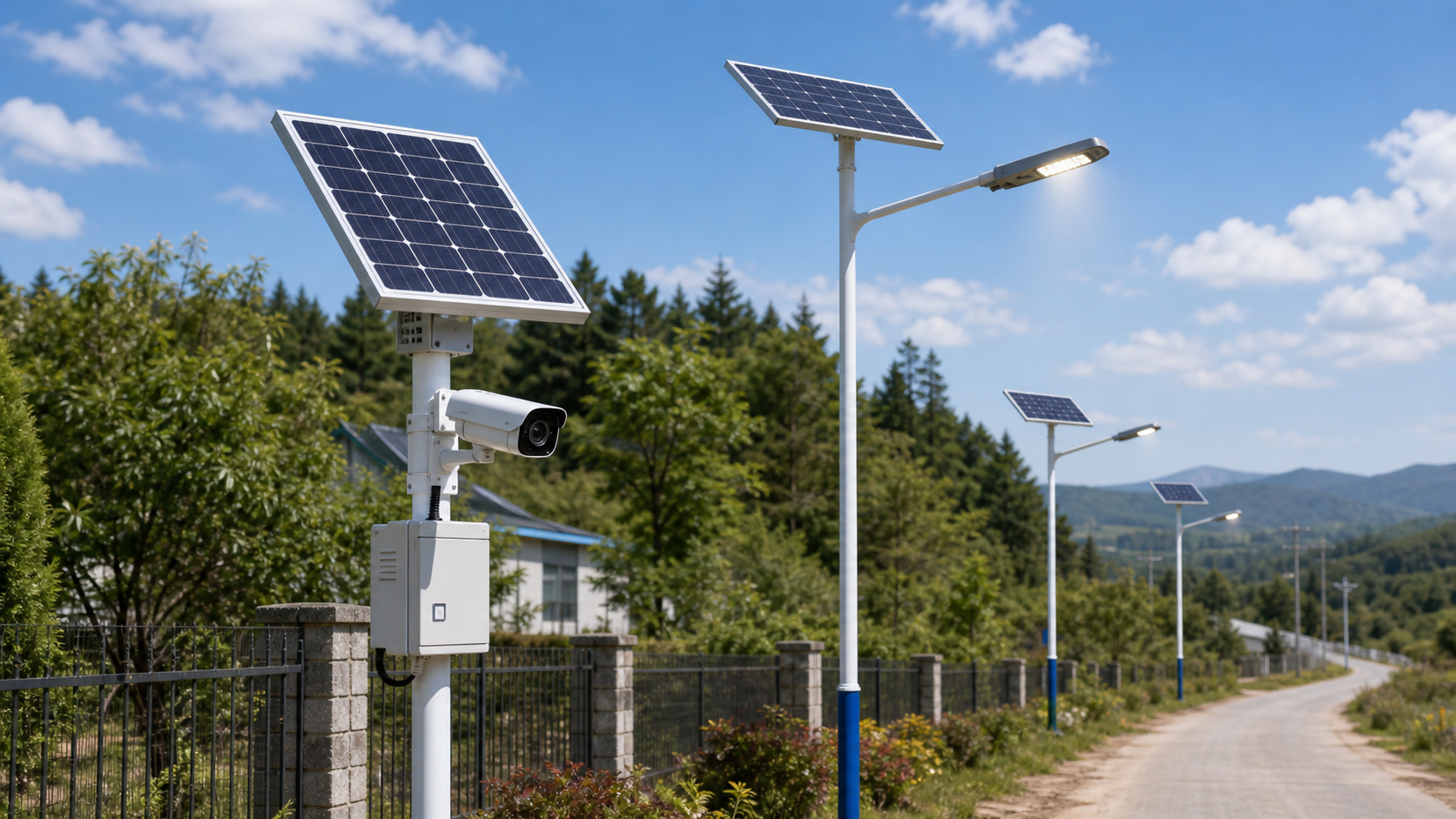
For the light, record the required illumination, hours of operation and permitted dimming pattern. Electrical watts alone do not establish whether the road or working area is adequately lit. The lighting designer should approve the optical layout and any reduced-light periods before those periods are used to reduce the energy estimate.
The Signify SunStay Pro gen2 mini documentation links autonomy to dimming and sensing options and calls for site-specific sizing. It is a useful reminder that operating profiles are part of the design, not a free saving that applies to every luminaire.
For the camera, decide whether the requirement is continuous recording, event-triggered clips or periodic images. Include the router, wireless bridge, recorder or PoE equipment needed to deliver that service. A camera can remain powered while the network link fails, so successful power-up is not the same as usable remote surveillance.
Axis explains in its December 2025 camera power white paper that newer typical-power figures can exclude infrared illumination and heaters. Maximum consumption represents a different operating condition. Read the exact datasheet labels and test the intended night, recording and temperature settings.
Use a realistic energy profile for storage calculations and the required maximum supply capability for the power interface. These are separate checks. The Axis power-profile guidance also cautions that lower average consumption does not remove a camera’s required PoE power-source rating. Do not select a smaller injector merely because a daytime measurement looks low.
The example below is hypothetical, not a Suntrica kit specification. Assume a 12-hour lighting night, measured input of 20 W during the first five hours and 8 W during the next seven, a camera averaging 6 W over its agreed day/night duty, and the additional loads shown. The 8 W figure is an assumed electrical measurement, not a conversion from a brightness percentage.
| Load | Assumed input | Daily operation | Daily energy |
|---|---|---|---|
| Light at initial setting | 20 W | 5 h | 100 Wh |
| Light at reduced setting | 8 W | 7 h | 56 Wh |
| Camera | 6 W average | 24 h | 144 Wh |
| Network equipment | 4 W average | 24 h | 96 Wh |
| Other fixed auxiliaries | 2 W | 24 h | 48 Wh |
| Total at the defined loads | Not a peak-power rating | One assumed day | 444 Wh |
Energy is power multiplied by operating time. The light accounts for 156 Wh, but the complete system needs 444 Wh per assumed day before the separately allowed delivery losses. Longer winter nights, active heaters or additional radios change this result. Measure consistently so that a loss or auxiliary load is not counted twice.
Two days with no useful solar generation would require 888 Wh at those loads. If the permitted usable fraction of nominal battery energy were 80% and battery-to-load efficiency were 90%, the simple nominal-energy screen would be 888 / (0.80 x 0.90) = approximately 1233 Wh, or about 1.24 kWh rounded upward. Ageing, cold-weather operation, charge limits and the selected equipment may require further allowance. This is not a recommended battery model.
Now consider replenishment. Using an assumed three peak-sun-hours per day and an overall 70% PV-to-load energy factor, daily balance alone gives 444 / (3 x 0.70) = approximately 212 Wp rounded upward. That would only balance the assumed ongoing use; it does not provide a meaningful allowance for rebuilding a depleted reserve.
To replace a two-day 888 Wh load-equivalent deficit over two later days while still supplying 444 Wh each day, the simplified screen becomes (444 + 888 / 2) / (3 x 0.70) = approximately 423 Wp. The 70% factor is an assumed aggregate factor for this separate PV illustration, not an extra factor to multiply into the battery example. Actual recovery also depends on charge acceptance, controller limits and the weather sequence.
Use site and seasonal data instead of treating those assumptions as local conditions. The European Commission’s PVGIS off-grid documentation describes a time-series approach that considers consumption and battery state. No site simulation has been performed for the example above.
Confirm module Vmp, cold-condition Voc, current limits and the battery charging profile against the exact controller. Use the MPPT controller matching guide for that separate task. Panel wattage alone does not establish electrical compatibility.
Check whether the controller’s load output is continuous or dusk-to-dawn switched. A camera that needs continuous power must not unknowingly share a light output that turns off at sunrise. Any separate supply branch needs an approved protected design; do not improvise a bypass around battery protection.
For mounting, assess shading at the proposed height, panel orientation, wind loading, cable exposure and service access. A larger module can improve the energy balance while exceeding the pole’s approved mechanical arrangement. Have the responsible installer check the entire assembly and verify both live video and light output after dark.
Only after reviewing spare energy, reserve, charging capacity and the power interface. A spare connector or a battery that appears full at midday is not enough evidence.
No. Some devices remain active while deciding when to record. Confirm actual operating modes and network consumption rather than assuming the camera sleeps between events.
It may extend the reserve, but it will not correct a persistent generation shortfall. Review the complete load and the time required to recharge before the next low-sun period.
Send the timed load list, device datasheets, site location and pole constraints through Contáctanos. Suntrica coordinates small off-grid module options with suppliers. The final panel, controller, battery and camera interfaces must be confirmed together; the example is not a ready-made lighting or surveillance package.
Learn how to choose a 3–8kW single-phase hybrid solar inverter by matching household loads, PV string voltage, MPPT current, 48V battery capacity, backup circuits, grid requirements and future expansion.
Ver detalles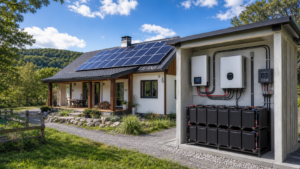
Solución de sistemas de energía solar autónomos para granjas, viviendas, lugares remotos y proyectos comerciales de energía de reserva, que incluye paneles, inversores híbridos y baterías a juego.
Ver detalles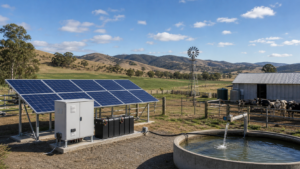
Plan remote farm solar around seasonal work, water storage, cold rooms and night loads. Use a service-priority sheet and check backup responsibilities.
Ver detalles
Check a wall mounted home battery's structure, location, service access and inverter interface. Use a site survey and document checklist before installation.
Ver detalles