 Suntrica — решения в области солнечной энергетики








НАЙДИТЕ ТО, ЧТО ВАМ НУЖНО
Поиск по всему сайтуПродуктНовости
ПОИСК
Select an MPPT solar charge controller by checking both sides of the device: the PV array’s voltage and current limits, and the battery’s permitted charging voltage and current. A charger marked 60 A does not necessarily accept 60 A from the panels. Nor does a compatible battery voltage prove that a proposed panel string is safe.
This guide concerns battery-charging controllers in off-grid systems. A solar pump drive may also use maximum power point tracking, but its motor output and control requirements are different. For that application, use the solar water pump controller guide.
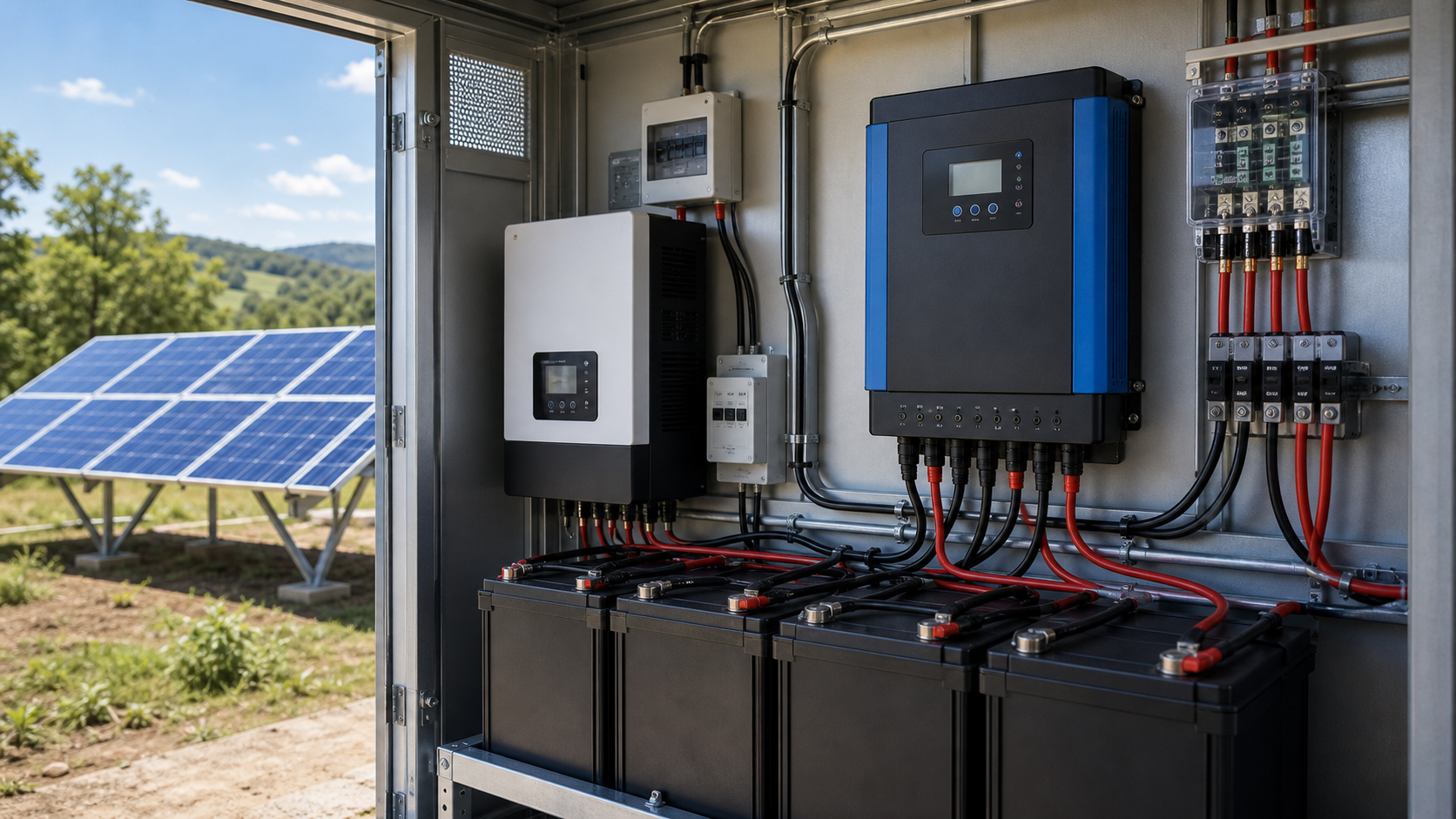
An MPPT charger adjusts the PV operating point and converts available power into a suitable battery-charging output within its limits. Victron’s SmartSolar introduction explicitly distinguishes maximum PV voltage from maximum battery charging current. Naming conventions differ by manufacturer, so read the specification table instead of decoding an unfamiliar model name by analogy.
| Check | Evidence needed | What it does not prove |
|---|---|---|
| PV open-circuit ceiling | Array Voc corrected for design cold conditions | That hot-condition operating voltage is suitable |
| MPPT and startup window | Module Vmp, temperature data and controller start requirements | Permission to exceed the absolute voltage ceiling |
| PV input current | Allowed operating and short-circuit current for the actual input | That the battery charge-current rating is the PV limit |
| Battery charging output | Supported voltage, adjustable profile and total permitted current | Compatibility with every battery of that nominal voltage |
| Load terminals | Separate output rating and approved load types | A general-purpose supply for a large inverter or motor |
For a concrete supplier example, the Techfine MB60415 listing separates system-voltage-dependent charging power, PV voltage conditions and load-output current. Its 60 A headline is not a substitute for all those checks. Request the current model manual and clarification of any missing PV input-current limit before proposing parallel strings.
For identical series modules, voltages add. In many PV modules, open-circuit voltage rises as cells cool; use the exact module coefficient and the manufacturer’s design method. Victron’s PV array guidance specifically calls for checking Voc and its temperature coefficient. Its product limits are not specifications for Techfine or SIY equipment.
Illustrative inputs only: module Voc is 45 V at 25 C, the coefficient is minus 0.28 percent per C, and the selected design cell temperature is minus 10 C. The simplified linear estimate is 45 x [1 + 0.0028 x 35] = 49.41 V per module. Three modules in series give 148.23 V, compared with 135 V at the reference temperature.
A hypothetical 150 V controller ceiling would leave very little room in that example. Do not approve the string from this calculation alone: module tolerances, the correct site design temperature, controller-specific conditions and required design allowances remain unresolved. These values are not a SIY datasheet or a recommended installation. Hot-condition Vmp and startup checks must also pass.
Assume a hypothetical array is actually delivering 1200 W at the controller input at one moment, and the battery-side voltage is 28.8 V. Ignoring conversion losses gives 1200 / 28.8 = 41.7 A. With an illustrative 96 percent conversion efficiency, output current is 1200 x 0.96 / 28.8 = 40 A, before separate auxiliary consumption. The efficiency and voltage are assumptions, not product claims or recommended settings.
This explains why panel current and battery charging current can differ. It does not size the whole installation: at another battery voltage or operating condition, the current changes. The charger’s own limit, the battery/BMS limit and other simultaneous charging sources can restrict the permitted output. Loads on the same DC bus can also reduce the net current entering the battery.
A high current rating says nothing about how many hours that current will be available. For the separate daily energy question, use the panel wattage and battery recharge guide.
Obtain the battery manufacturer’s permitted charging profile, current range, temperature conditions and requirements for charger shutdown or communication. A lithium option in a menu does not establish compatibility with every pack. Do not use a lead-acid equalization setting on a lithium battery unless its manufacturer explicitly specifies such a function.
Record who sets the charge limits and what happens if communication is lost or the BMS stops charging. Monitoring connectivity and protective control are different functions. A shared RS485 connector alone does not establish an approved protocol or coordinated charging behaviour.
Victron’s model specification table also separates load-output ratings and temperature-dependent capability. Ask for the equivalent evidence for the selected charger, including enclosure conditions, cooling and the allowed PV power at the chosen battery voltage.
If one field is unknown, keep it marked unresolved. Do not substitute a product photograph, a different model’s manual or the battery’s amp-hour capacity for the missing electrical limit. Installation, isolation and protective-device selection belong to qualified personnel.
Only within the manufacturer’s permitted array design. Output limiting is not permission to exceed PV open-circuit voltage, input-current limits or allowed array power. Recheck the complete configuration before expansion.
Not merely because both use MPPT. A pump requires the correct motor drive, operating range and protection functions. Select a matched pump/controller arrangement rather than treating the two devices as interchangeable.
No. A full battery, limited sunlight, shading, temperature, programmed limits or battery control can reduce charging. Compare operating conditions and logged data with the manual before changing hardware.
Send the module datasheet, proposed string layout, battery/BMS information, charger model and installation conditions to Suntrica. Our солнечные панели и storage batteries require an explicit compatibility review; listing both does not mean every combination is approved.
Reviewed 22 September 2026. Examples are for preliminary checking only. Use exact equipment documents and qualified electrical design before procurement or installation.
Оцените число панелей мощностью 400–600 Вт для инвертора 5 кВт. Проверьте диапазон MPPT, ток, Voc на морозе и потребность в зарядке аккумулятора.
Посмотреть подробности
Plan off-grid telecom solar power around DC interfaces, continuous demand, battery recovery and actionable alarms. Review service priorities before ordering.
Посмотреть подробности
Choose single or three phase solar inverters using per-phase loads, outage requirements and an overload example. Check split-phase and expansion limits.
Посмотреть подробности
Выбор контроллера солнечного насоса по двигателю, напряжению, току, входу ФЭ-модулей и защите уровня воды. Проверки перед запросом предложения.
Посмотреть подробности