 Soluções de Energia Solar Suntrica








PROCURE O QUE QUISER
Pesquisar tudoProdutoNotícias
PESQUISAR
A remote farm solar power system should be planned around the farm’s operating calendar, not just the combined wattage of its equipment. Irrigation, refrigeration, workshops and staff housing use electricity at different times and have different consequences when power is limited. The first design decision is which services must continue, which can move to daylight, and which need an independent backup.
This guide is for farms coordinating several uses of electricity. If the project is only a dedicated irrigation pump, start with the irrigation solar-panel sizing guide. A pump-only installation and a farm electrical supply are not interchangeable.
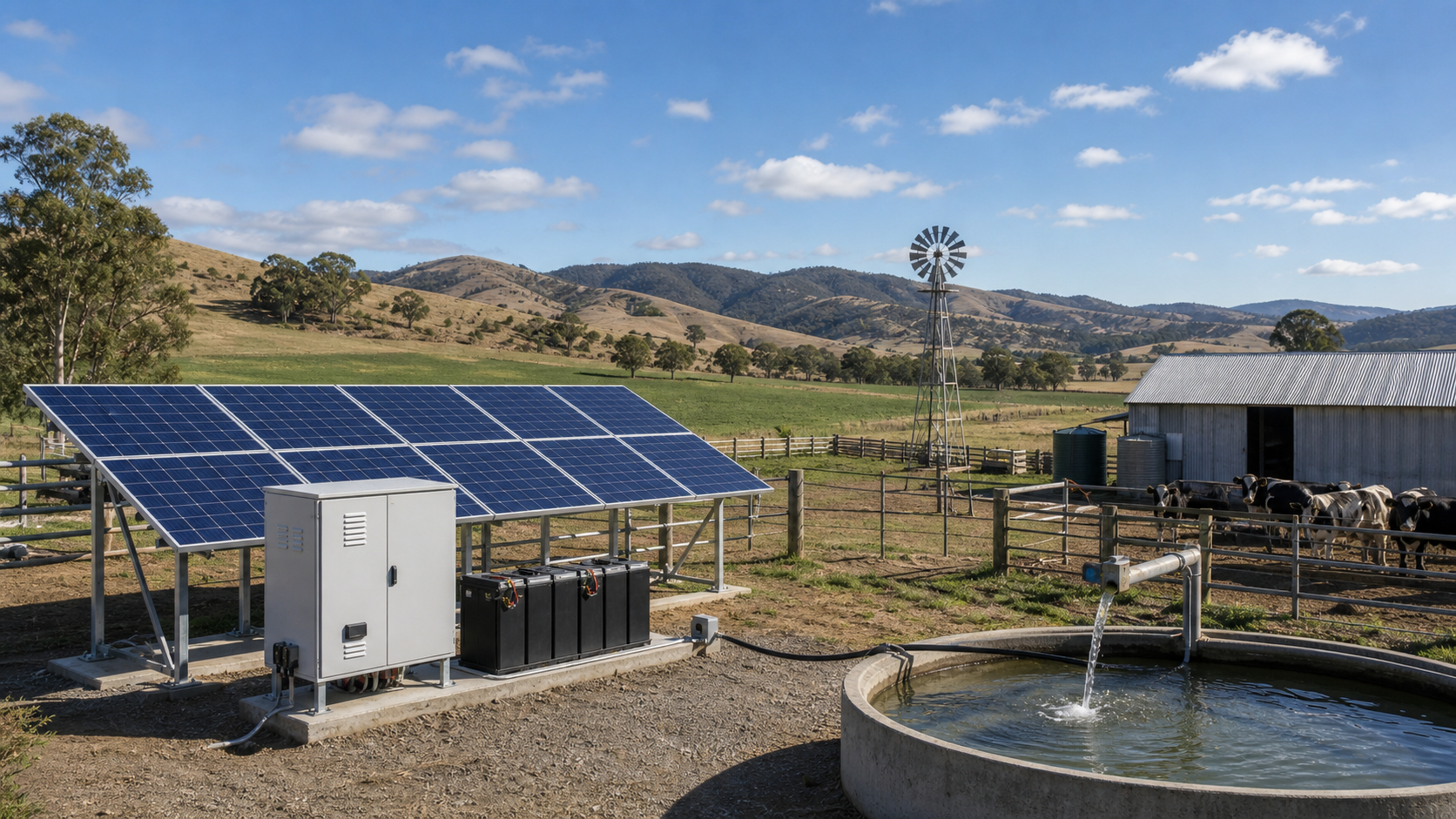
Mark the borehole, tank, processing area, cold store, workshop and occupied buildings on a site plan. Record distances, existing supplies and the people responsible for each service. A central inverter may simplify supervision, but long distribution routes and one shared point of failure can change the comparison with separate supplies.
In its August 2026 Anna Creek project account, Victron describes MyEnergy Engineering’s work for Williams Cattle Company, covering farm machinery, refrigeration, accommodation and communications while retaining generator backup. It is a useful example of mixed operating needs, not a capacity recommendation or a Suntrica project.
Separate the list into services that protect people or essential operations, services with a fixed production deadline, and discretionary work. The farm operator must approve these priorities. Do not assume that refrigeration, animal-water supply or a safety system may be interrupted because its average energy use looks small.
Use a separate sheet for the busiest irrigation period, harvest or processing season, and the lowest-sun period. Include occupancy changes and the longest realistic delay before maintenance can reach the property. The following questions identify scheduling opportunities without treating them as automatic permission to interrupt a load.
| Farm service | Operating evidence | Decision to record |
|---|---|---|
| Water abstraction | Daily volume, pumping head, source yield and refill window | Dedicated pump supply or shared electrical system |
| Cold storage | Measured daily energy, startup demand and approved temperature limits | Required continuity and emergency response |
| Workshop equipment | Motor ratings, phases, startup sequence and job duration | Permitted daylight work and loads that cannot overlap |
| Housing and lighting | Occupied rooms, evening hours and seasonal appliances | Night supply allowance and excluded high-energy uses |
| Controls and communications | Continuous input demand and loss-of-connection behaviour | Independent reserve and named alarm recipient |
| Expansion | Specific next machine, building or water demand | Documented interface and staged capacity review |
Consider a hypothetical day with a pump drawing 1.2 kW for 3 hours, a workshop load of 0.8 kW for 1.5 hours, cooling measured at 2.4 kWh per day, and evening services using 0.6 kWh. The total is 3.6 + 1.2 + 2.4 + 0.6 = 7.8 kWh at the loads, before conversion, wiring and system standby losses. These are example inputs, not equipment specifications.
Moving the workshop work away from pumping may reduce their simultaneous running demand from 2.0 kW to the larger individual load, before adding other concurrent loads. It does not remove the 4.8 kWh those two activities consume. Motor startup, cooling demand and the actual phase arrangement still need separate checks; see the motor startup and inverter surge guide.
Running flexible work during strong sunlight can reduce the energy drawn through storage. However, the operating rule needs a low-solar exception. A production deadline does not disappear when clouds arrive, and an automatic restart must not create an unsafe machine operation.
Where suitable, a tank can separate the time water is pumped from the time it is used. Its useful reserve depends on demand, usable volume, refill rate and distribution pressure. It cannot power lights or refrigeration, and a full tank does not prove that the source can support the next dry period.
A dedicated solar pump controller is not a general household electricity outlet. Sharing a PV array or power source between pumping and other equipment requires an explicitly supported design. Ask the integrator to document the operating modes instead of assuming spare pump-panel capacity can be connected elsewhere.
FAO’s irrigation-management guidance warns that cheaper solar pumping can increase pressure on groundwater unless abstraction is managed. Source yield, permitted extraction and crop-water planning remain constraints even when sunshine is available.
Write a practical sequence for low stored energy: who receives the warning, which approved jobs are postponed, when a backup source is used and how service is restored. Generator availability includes fuel, servicing, operator access and compatible controls, not just a generator shown on a quotation.
Ask the installer to review cable routes, protection, earthing, dust, flooding, heat and access for cleaning or replacement. These require site-specific design. Keep model numbers, configuration records and spare-part references available to the maintenance team, including when internet access is unavailable.
Not necessarily. Compare distances, operating hours, electrical interfaces and the effect of a shared failure. A separate pumping supply may be useful, but it needs its own sizing, controls and service plan.
Only if charging and generation can replenish it while serving the ongoing loads. Added storage does not correct a persistent energy shortfall or an inverter that cannot start the machinery.
No. Agronomy, water availability, distribution pressure and the permitted irrigation window may prevent that. Evaluate storage and scheduling with the farm’s water-management requirements.
Send the site map, seasonal service sheet, equipment labels and existing backup details through Contacte-nos. Suntrica can coordinate solar water-pump options e off-grid component matching with suppliers. The final operating plan and installation must be reviewed for the actual farm.

Verify a China solar supplier through model documents, certificate scope, batch inspection and delivery records. Use an evidence checklist before bulk orders.
Ver detalhes
Choose single or three phase solar inverters using per-phase loads, outage requirements and an overload example. Check split-phase and expansion limits.
Ver detalhes
Plan solar OEM ODM cooperation with sample acceptance, batch release checks, revision control and private-label certification review for each product.
Ver detalhes
Compare commercial solar payback using onsite consumption, export value and installed cost. Review a worked sensitivity example and avoid double-counted savings.
Ver detalhes