 Solusi Energi Surya Suntrica








CARI APA YANG ANDA INGINKAN
Cari semuaProdukBerita
PENCARIAN
A wall mounted lithium battery is suitable for home backup only when the exact battery, supporting structure, environment and inverter interface are approved together. A compact enclosure does not establish that a wall can carry it, that it may be installed outdoors, or that it can power household AC appliances by itself.
Use this guide before agreeing on the installation location. For electrical capacity and discharge capability, see the separate LiFePO4 battery comparison guide. The decision here is whether the proposed physical arrangement is practical, serviceable and supported by the equipment documentation.
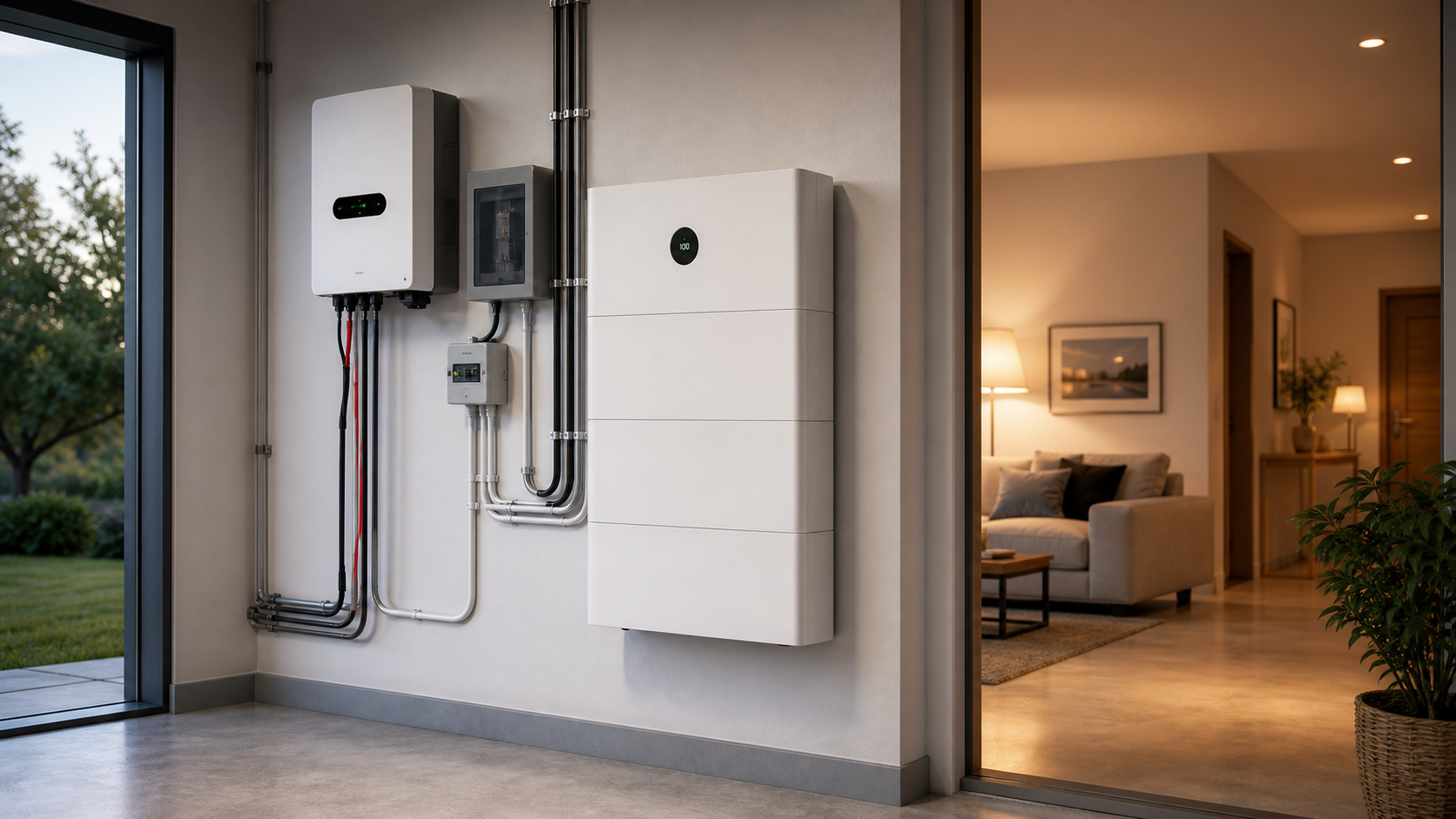
Record the manufacturer, full model suffix, capacity variant, enclosure revision and mounting kit. Similar front covers can hide different weights, terminal positions and mounting arrangements. A floor-standing variant must not be treated as a wall model because it belongs to the same product family.
For a concrete reference, Techfine’s LB series page lists 54.5 kg as the reference net weight of the LB100AH/51.2VTA variant. That is not the weight of every LB battery or of the separate LC family. Confirm the current supplied unit and approved support method before ordering; do not select fixings from a catalogue photograph.
A complete site review includes the battery, bracket and any other equipment using the same structure. Tesla’s Powerwall 3 mounting guidance illustrates how an established manufacturer ties mounting configuration to structural conditions. Its approved details apply to that product, not to Techfine or other batteries.
The homeowner can provide photographs and dimensions without opening electrical equipment. The installer must assess the structure, wiring route and applicable local requirements. Use the following record to separate known facts from items still awaiting approval.
| Survey item | Evidence to collect | Approval needed |
|---|---|---|
| Supporting structure | Wall construction, condition and other supported equipment | Installer or structural review of the actual load and anchoring |
| Available space | Measured wall area, adjacent equipment and obstructions | Model-specific clearances and service access |
| Environment | Indoor or outdoor exposure, heat, cold, moisture and possible flooding | Permitted location and operating conditions for the enclosure |
| Access route | Doorways, stairs, lifting access and future removal path | Handling plan for the actual unit weight |
| Cable route | Distance to inverter, protected route and terminal access | Cable and protection design by a qualified installer |
| Expansion space | Proposed additional modules and future access | Mechanical and electrical review of the expanded arrangement |
A blank entry is not an automatic rejection, but it should remain an open action. For example, a battery may fit between two cabinets while leaving insufficient room to remove its cover or isolate it. The useful drawing shows the clearance envelope and access path, not just the enclosure outline.
Do not assume that a metal case is weatherproof. The LB page lists IP21 for that family; obtain the current installation manual and permitted environment rather than interpreting this as permission for exposed outdoor use. A sheltered balcony, a damp garage and an indoor utility area have different exposure conditions.
Record the likely temperature at the battery location, including direct sun and nearby heat sources. Ask separately about charging and discharging temperatures. A battery that can discharge in cold conditions may still restrict charging. For comparison, the Victron SuperPack NG operating instructions describe a model-specific heater and charge-blocking sequence. Do not assume another battery has the same feature.
Any enclosure, ventilation arrangement or weather protection must be accepted for the selected equipment. Adding an improvised closed cabinet can change cooling and servicing conditions. Keep escape routes and access to protective equipment subject to the local installer’s review; this article does not prescribe a universal separation distance.
Most low-voltage wall battery modules supply DC power. A compatible inverter and the rest of the backup installation are needed to deliver AC power to household circuits. Confirm the inverter’s battery voltage window, permitted current, communication protocol, cable pinout, firmware and response to a lost battery signal.
For the 51.2V wall battery range, request the exact model’s current data sheet and installation manual. A CAN or RS485 port identifies an interface, not approval for every inverter with a similarly shaped socket. Ask which communication cable and settings are included in the quotation, and which must be supplied locally.
Match documentation to the actual battery and proposed system. In its energy storage standards explanation, UL distinguishes the UL 9540 product-system safety standard from the UL 9540A thermal-runaway test method. A reference to one is not interchangeable with the other. Applicable requirements depend on the destination and approved configuration; this is not a claim that a Suntrica product holds either approval.
If later expansion is intended, obtain written rules for compatible modules, age differences and firmware before buying the first unit. Extra wall space alone does not establish electrical compatibility or available inverter capacity.
No. The finish does not reveal the load-bearing structure or anchor suitability. Have the installer assess the actual wall against the battery manufacturer’s instructions. An alternative approved floor or rack arrangement may be needed.
Not without confirmation for that model and location. Wind-driven rain, condensation, temperature and flooding exposure still matter under a roof. Request the permitted environment in writing before installation.
Not if it is a DC battery module. Some integrated storage products include an inverter, but that must be confirmed from their documentation. See the home backup operating guide for circuit and outage requirements.
Send the proposed location photographs, available dimensions and inverter model to Suntrica atau sunny@solar-machinery.com. As a trading and sourcing supplier, we can coordinate model documents with the manufacturer. Structural approval and electrical installation remain the responsibility of qualified local professionals.
Size solar power for street lights and security cameras from timed loads, night operation and cloudy-day recovery. Check battery reserve, PoE and mounting.
Lihat detailnya
Choose single or three phase solar inverters using per-phase loads, outage requirements and an overload example. Check split-phase and expansion limits.
Lihat detailnya
Check what a hybrid inverter powers during outages, including essential circuits, transfer limits, battery reserve and restart. Plan a witnessed handover test.
Lihat detailnya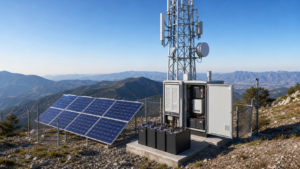
Plan off-grid telecom solar power around DC interfaces, continuous demand, battery recovery and actionable alarms. Review service priorities before ordering.
Lihat detailnya