 Suntrica - Solutions d'énergie solaire








RECHERCHEZ CE QUE VOUS VOULEZ
Rechercher dans tout le siteProduitActualités
RECHERCHE
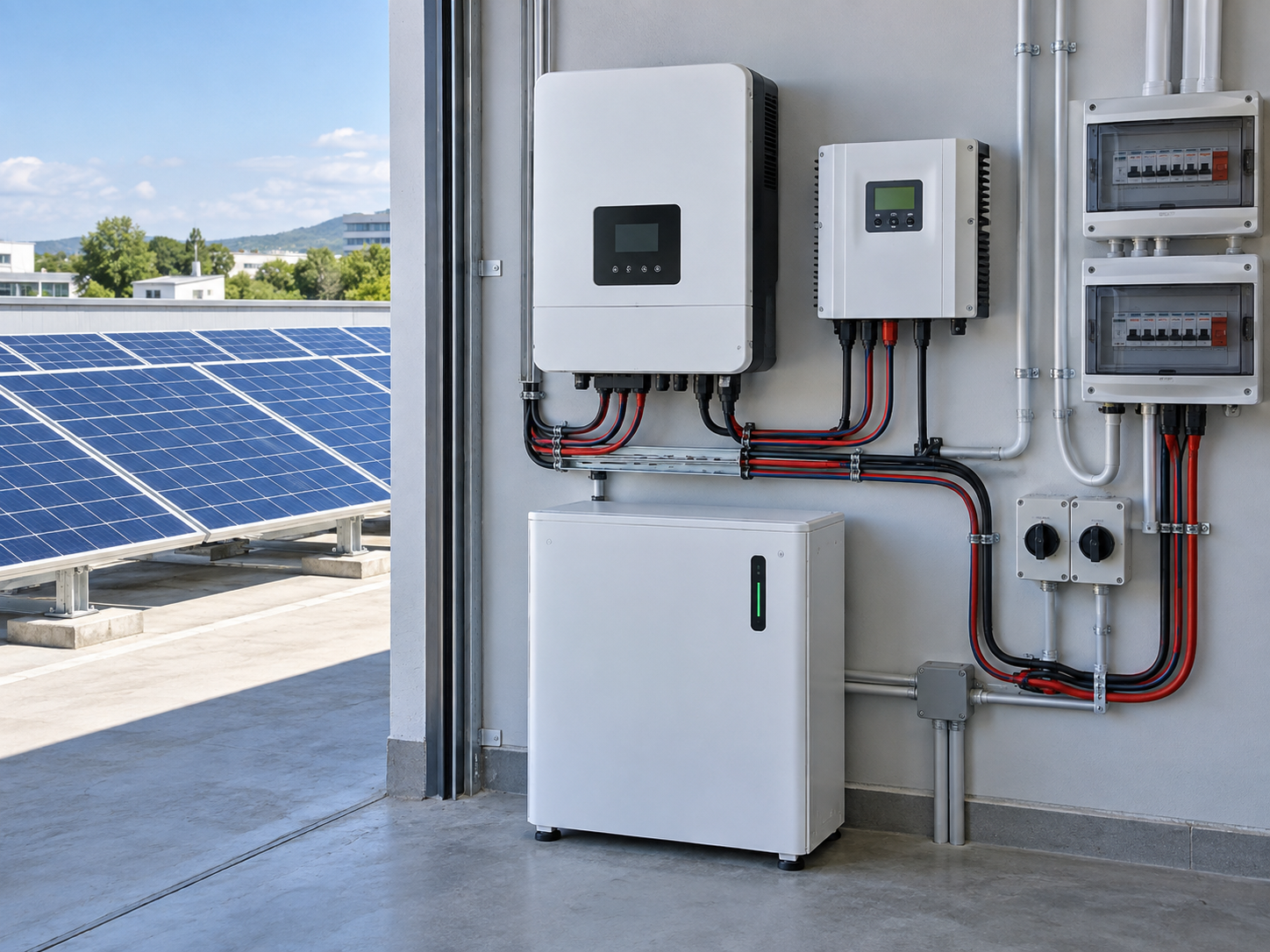
A reliable solar power system is not created by choosing the highest-wattage panel or the largest battery. It is created by matching the load profile, solar resource, PV array, charge control, inverter, battery, cables and protection devices as one electrical system. A mismatch in any one of these areas can reduce energy yield, prevent equipment from starting, shorten battery life or create a safety risk.
The same 3 kW of solar panels can serve very different projects. A grid-connected home may use the grid as its balancing resource. A hybrid system may reserve battery energy for critical loads during outages. A remote telecom site or farm must operate without a utility connection and therefore needs enough storage and design margin for poor weather.
Start by selecting the system architecture:
Record every intended load, its rated power, operating hours and time of use. Motors, compressors, pumps and power tools also need a startup-surge value. The result should show three different requirements:
Daily energy (Wh) = Load power (W) × Quantity × Operating hours
Separate essential loads from optional loads. Refrigeration, communications, lighting and selected pumps may need backup, while electric heating, large air conditioning and nonessential machinery may remain grid-only. This single decision can reduce battery and inverter size substantially.
A useful preliminary estimate is:
PV array size (kW) ≈ Daily energy (kWh) ÷ Peak-sun-hours ÷ System factor
The system factor allows for real-world losses from module temperature, soiling, shading, mismatch, wiring, power conversion and availability. It must reflect the site rather than being copied blindly from another project.
Illustrative example: a site using 9 kWh per day, with 4.5 peak-sun-hours and a preliminary system factor of 0.75, gives 9 ÷ 4.5 ÷ 0.75 = 2.67 kW. A designer might begin evaluating an array around 3 kW, then model monthly production, seasonal loads, shading and storage losses before confirming it.
NREL's PVWatts methodology treats losses such as soiling, shading, snow, mismatch, wiring, connections, nameplate rating, age and availability separately. This is a useful reminder that nameplate watts are not the same as delivered annual energy.
Module efficiency matters when installation area is limited, but it is only one selection criterion. Compare:
String voltage must be checked at temperature extremes. Cold weather raises module Voc, so the maximum string Voc must remain below the inverter or controller's absolute DC-input limit. Hot modules produce lower operating voltage, so string Vmp must remain inside the MPPT operating range under expected high-temperature conditions. Parallel strings also increase input current and must remain within the equipment's channel and connector limits.
A charge controller manages PV energy delivered to a battery and helps prevent operation outside the battery's permitted charging conditions. Many modern hybrid inverters include MPPT solar charge control internally; separate controllers are common in modular off-grid systems.
| Design point | PWM controller | MPPT controller |
|---|---|---|
| Operating principle | Connects the array to the battery through switched regulation, so array operation is closely tied to battery voltage. | Tracks the array's maximum-power operating point and converts voltage/current to suit battery charging. |
| Best fit | Small, simple systems where module and battery nominal voltages are closely matched. | Higher-power arrays, wider voltage differences, colder climates and projects needing more string-design flexibility. |
| Selection checks | PV current rating, battery voltage, module compatibility and charging profile. | Maximum PV Voc, MPPT range, input current, output charging current and battery profile. |
Do not assume a universal percentage gain for MPPT. The real difference depends on array voltage, battery voltage, module temperature, irradiance, cable losses and controller design. Use the selected manufacturer's efficiency curves and operating limits.
The inverter converts DC electricity to AC and often performs monitoring, protection, grid interaction and battery management. Check all of the following:
String inverters are practical for many residential and commercial arrays. Microinverters allow module-level conversion and can reduce the effect of a shaded or damaged module on other modules, but they change cost, service access and system architecture. Central inverters are generally used at larger project scales. A hybrid inverter adds battery charging and backup functions, but the words “hybrid” and “backup” do not guarantee that every household circuit can operate during an outage.
Battery capacity in kWh determines how long loads can run. Battery power in kW determines which loads can run at the same time. Both must satisfy the project.
Nominal battery energy ≈ Required AC energy ÷ Usable depth of discharge ÷ Conversion efficiency
Illustrative example: if essential loads need 6 kWh during an outage, the battery permits 80% usable depth of discharge and the assumed DC-to-AC efficiency is 92%, the preliminary nominal capacity is 6 ÷ 0.80 ÷ 0.92 = 8.15 kWh. Temperature, aging reserve, standby consumption, required autonomy and the manufacturer's operating limits may increase the final capacity.
For lithium batteries, verify the BMS charge/discharge current, short-duration peak current, supported inverter communication and permitted parallel quantity. For lead-acid batteries, usable depth of discharge, charging stages, ventilation and maintenance have a much larger influence on lifetime. Never mix batteries of different chemistry, voltage, age or specification unless the manufacturer expressly approves the configuration.
A technically correct panel-and-inverter combination can still fail because of undersized cable, poor connectors, missing isolation or unsuitable enclosures. The design should address:
PV arrays can remain energized whenever exposed to light. Final electrical and structural design, installation and commissioning should be completed by qualified professionals under applicable local codes, utility rules and manufacturer instructions.
For a useful quotation, provide the project country and city, utility voltage/frequency/phase, a load list with operating hours, surge loads, required backup time, roof or land dimensions, shading information, site photographs, temperature range and any required certifications. For off-grid projects, include the number of autonomy days and the backup generator strategy, if any.
Suntrica supplies solar panels, solar inverters and energy-storage batteries for residential, commercial and remote-power projects. Send us your load profile, site conditions and required backup time for component matching.
View Solar PanelsView Solar InvertersRequest System Matching

Check solar inverter startup loads using W, VA, surge duration and battery limits. Read GD model ratings without assuming an unsupported surge time.
Voir les détails
Check a wall mounted home battery's structure, location, service access and inverter interface. Use a site survey and document checklist before installation.
Voir les détails
Learn how to choose a 3–8kW single-phase hybrid solar inverter by matching household loads, PV string voltage, MPPT current, 48V battery capacity, backup circuits, grid requirements and future expansion.
Voir les détails
Prepare a solar project quotation with product-specific RFQ fields, a reusable inquiry template, evidence checks and a clearly defined supply scope.
Voir les détails