 Soluciones de energía solar Suntrica







BUSCA LO QUE QUIERAS
Buscar en todoProductoNoticias
BUSCAR
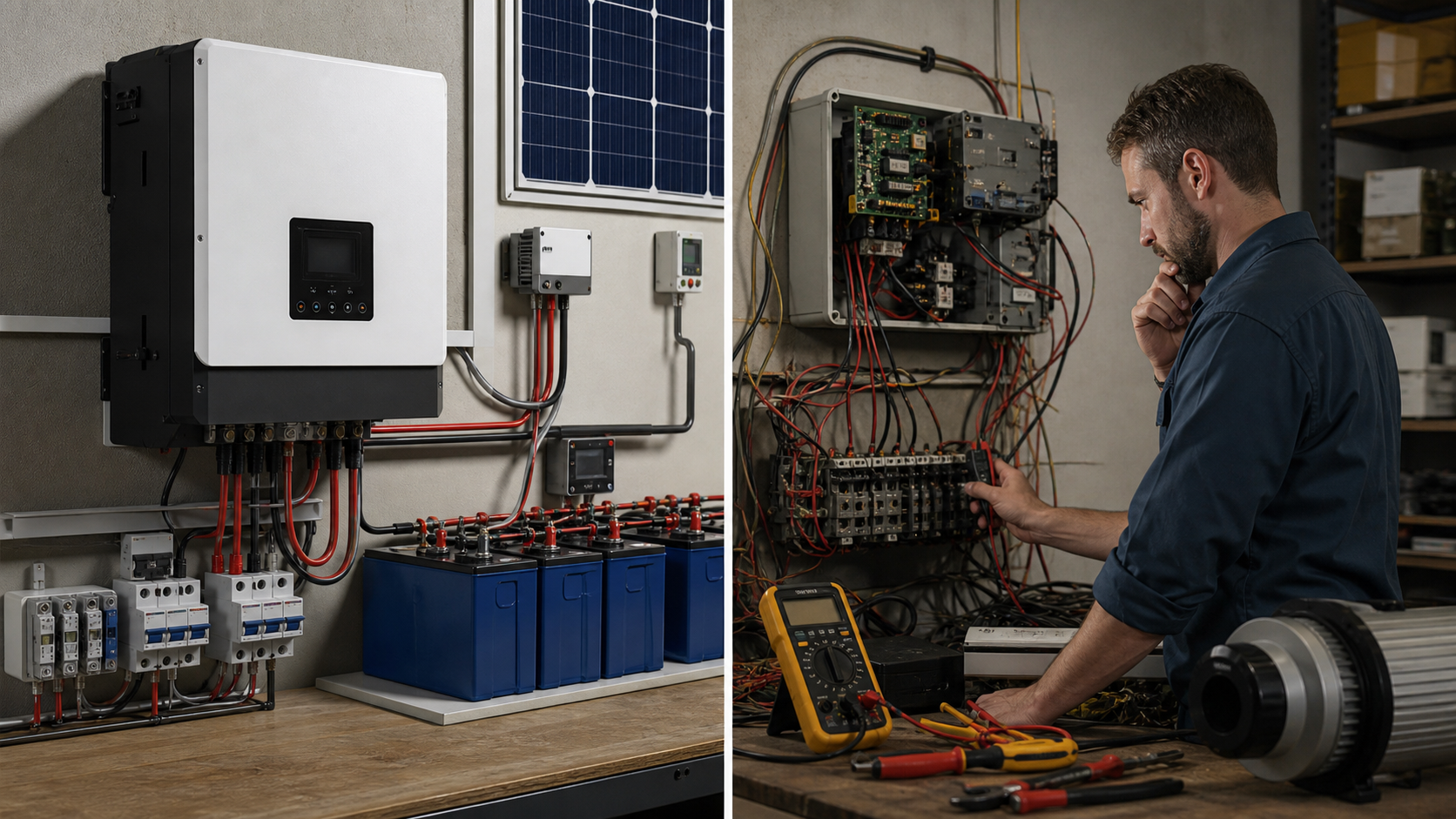
Off grid solar inverter selection and wiring review
Buying a solar inverter for an off-grid system is not only about choosing a model with enough power. Many buyers focus too much on price or wattage and overlook the actual operating conditions of the project. As a result, the inverter may not match the battery voltage, may fail to support startup loads, or may not work efficiently with the solar panel configuration. A wrong choice at this stage often leads to poor system performance and unnecessary replacement cost later.
One common mistake is underestimating real load demand. Some buyers only add up the rated power of appliances and ignore surge power from pumps, refrigerators, air conditioners, or motor-driven devices. In practice, these loads often require a much higher startup current than their normal running current. If the inverter cannot handle that surge, the system may trip, restart, or fail to run the equipment properly.
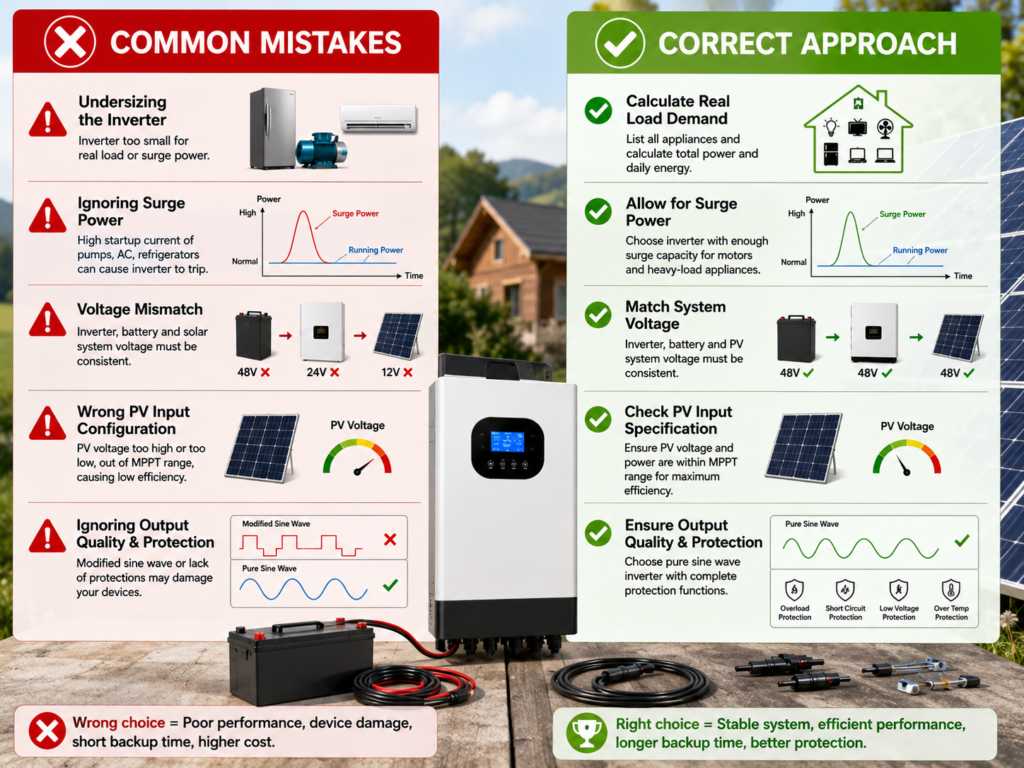
Another frequent problem is poor matching between the inverter, battery, and solar input. An inverter must match the system voltage, battery type, and charging requirements. Buyers sometimes choose a model without checking battery compatibility, MPPT range, maximum PV input, or charging current. This can lead to low charging efficiency, unstable battery performance, or wasted solar energy during operation.
Some buyers also overlook output quality and protection functions. For off-grid systems that power household appliances, communication devices, or sensitive electronics, pure sine wave output is usually the safer choice. Protection features such as overload protection, short-circuit protection, over-temperature protection, and low-voltage shutdown are equally important. Without them, both the inverter and connected equipment may face higher operating risk.
The best way to avoid these mistakes is to prepare complete project data before buying. Buyers should confirm load type, daily energy use, battery voltage, backup time, solar panel configuration, and installation environment. A good inverter is not simply the cheapest or the largest model. It is the one that matches the real application and keeps the whole off-grid system stable over time.
Learn how to match a hybrid solar inverter with battery storage by checking voltage, capacity, charging current, communication and load demand.
Ver detalles
A solar water pump can run without batteries by using direct PV power. Compare water storage, battery and hybrid options and learn the inputs needed for sizing.
Ver detalles
Learn how to plan a residential solar backup system with solar panels, hybrid inverter, LiFePO4 battery storage and essential load matching.
Ver detalles
Use this commercial rooftop solar checklist to review roof space, load demand, solar panels, inverter matching, storage options and project data.
Ver detallesFor project matching, wholesale supply or OEM/ODM cooperation, Ponte en contacto con Suntrica o debatir sobre la cooperación. También puedes ponerte en contacto con nosotros a través de WhatsApp o llama +86 185 1610 1196.